Ch. 10 - Photosynthesis
Campbell - Campbell Biology 12th Edition
Urry12th EditionCampbell BiologyISBN: 9785794169850Non è quello che usi tu?Cambia libro di testo
Capitolo 10, Problema 3

How is photosynthesis similar in C4 plants and CAM plants?
a. In both cases, only photosystem I is used.
b. Both types of plants make sugar without the Calvin cycle.
c. In both cases, rubisco is not used to fix carbon initially.
d. Both types of plants make most of their sugar in the dark.

Guida verificata passo dopo passo
1
Understand the basic process of photosynthesis, which involves converting light energy into chemical energy stored in glucose. This process generally includes two main stages: the light-dependent reactions and the Calvin cycle.
Recognize that C4 and CAM plants have adapted mechanisms to efficiently fix carbon in environments where photorespiration is a concern. Photorespiration occurs when the enzyme rubisco fixes oxygen instead of carbon dioxide, leading to a wasteful process.
Learn that in C4 plants, carbon fixation occurs in two different cell types. Initially, carbon dioxide is fixed into a four-carbon compound by an enzyme called PEP carboxylase, which does not use rubisco. This compound is then transported to another cell type where the Calvin cycle occurs.
Understand that CAM plants fix carbon dioxide at night when the stomata are open, storing it as a four-carbon acid. During the day, the stored carbon is released for use in the Calvin cycle. This process also initially uses PEP carboxylase instead of rubisco.
Conclude that both C4 and CAM plants initially fix carbon using PEP carboxylase, not rubisco, which is a key similarity in their photosynthetic processes. This adaptation helps minimize photorespiration and increase efficiency in carbon fixation.

Risposta video verificata per un problema simile:

Questa soluzione video è stata consigliata dai nostri tutor come utile per risolvere questo problema.
Durata del video:
1m

Concetti chiave

Ecco i concetti essenziali che devi comprendere per rispondere correttamente alla domanda.

Photosynthesis

Photosynthesis is the process by which plants, algae, and some bacteria convert light energy into chemical energy stored in glucose. It involves two main stages: the light-dependent reactions and the Calvin cycle. The light-dependent reactions capture sunlight to produce ATP and NADPH, while the Calvin cycle uses these molecules to synthesize glucose from carbon dioxide.
Video consigliato:
05:58
Pigments of Photosynthesis

C4 Photosynthesis

C4 photosynthesis is an adaptation in some plants that allows them to efficiently fix carbon in hot and dry environments. It involves an initial fixation of CO2 into a four-carbon compound in mesophyll cells, which is then transported to bundle-sheath cells where the Calvin cycle occurs. This mechanism minimizes photorespiration and increases the efficiency of photosynthesis under stress conditions.
Video consigliato:
04:34
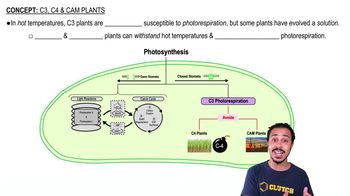
C3, C4 & CAM Plants

CAM Photosynthesis

CAM (Crassulacean Acid Metabolism) photosynthesis is a water-conserving adaptation found in some plants, allowing them to fix carbon dioxide at night. CAM plants open their stomata at night to capture CO2, storing it as malate. During the day, when stomata are closed to conserve water, the stored malate is used in the Calvin cycle to produce sugars, thus separating the processes temporally.
Video consigliato:
04:34
C3, C4 & CAM Plants