Ch. 10 - Photosynthesis
Campbell - Campbell Biology 12th Edition
Urry12th EditionCampbell BiologyISBN: 9785794169850Non è quello che usi tu?Cambia libro di testo
Capitolo 10, Problema 5

Which of the following occurs during the Calvin cycle?
a. Carbon fixation
b. Reduction of NADP+
c. Release of oxygen
d. Generation of CO₂

Guida verificata passo dopo passo
1
Understand the Calvin cycle: The Calvin cycle is a series of biochemical reactions that occur in the stroma of chloroplasts in photosynthetic organisms. It is part of the light-independent reactions of photosynthesis.
Identify the main processes of the Calvin cycle: The Calvin cycle involves three main stages: carbon fixation, reduction phase, and regeneration of ribulose bisphosphate (RuBP).
Carbon fixation: During this stage, carbon dioxide ( CO 2 ) is fixed into an organic molecule. This is the first step of the Calvin cycle.
Reduction phase: In this phase, ATP and NADPH produced during the light-dependent reactions are used to convert 3-phosphoglycerate into glyceraldehyde-3-phosphate (G3P). This involves the reduction of 3-phosphoglycerate.
Regeneration of RuBP: The final stage involves the regeneration of RuBP, allowing the cycle to continue. This does not involve the release of oxygen or generation of CO 2 .

Risposta video verificata per un problema simile:

Questa soluzione video è stata consigliata dai nostri tutor come utile per risolvere questo problema.
Durata del video:
5m

Concetti chiave

Ecco i concetti essenziali che devi comprendere per rispondere correttamente alla domanda.

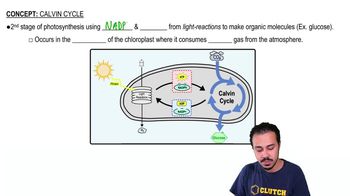
Calvin Cycle

The Calvin Cycle is a series of biochemical reactions that occur in the stroma of chloroplasts in photosynthetic organisms. It is part of the light-independent reactions of photosynthesis, where atmospheric carbon dioxide is fixed into organic molecules, ultimately producing glucose. The cycle involves three main stages: carbon fixation, reduction, and regeneration of ribulose bisphosphate.
Video consigliato:
03:42
Calvin Cycle

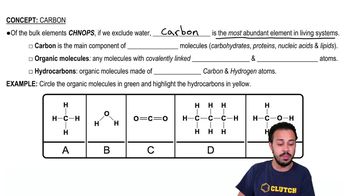
Carbon Fixation

Carbon fixation is the initial step of the Calvin Cycle, where carbon dioxide is incorporated into an organic molecule. This process is catalyzed by the enzyme RuBisCO, which combines CO2 with ribulose bisphosphate (RuBP) to form 3-phosphoglycerate (3-PGA). This step is crucial for converting inorganic carbon into a form that can be used by the plant to build sugars.
Video consigliato:
04:19
Carbon

Reduction Phase

During the reduction phase of the Calvin Cycle, ATP and NADPH produced in the light-dependent reactions are used to convert 3-phosphoglycerate into glyceraldehyde-3-phosphate (G3P). This involves the reduction of 3-PGA, where NADPH donates electrons, transforming it into G3P, a sugar molecule that can be used to form glucose and other carbohydrates.
Video consigliato:
03:21
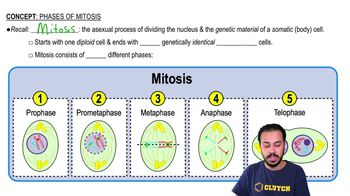
Phases of Mitosis
Pratica correlata
Domanda del libro di testo

Which of the following sequences correctly represents the flow of electrons during photosynthesis?

a. NADPH → O2 → CO2

b. H2O → NADPH → Calvin cycle

c. H2O → photosystem I → photosystem II

d. NADPH → electron transport chain → O2

2854
views
Domanda del libro di testo

How is photosynthesis similar in C4 plants and CAM plants?

a. In both cases, only photosystem I is used.

b. Both types of plants make sugar without the Calvin cycle.

c. In both cases, rubisco is not used to fix carbon initially.

d. Both types of plants make most of their sugar in the dark.

2748
views
Domanda del libro di testo

Which of the following statements is a correct distinction between autotrophs and heterotrophs?

a. Autotrophs, but not heterotrophs, can nourish themselves beginning with CO2 and other nutrients that are inorganic.

b. Only heterotrophs require chemical compounds from the environment.

c. Cellular respiration is unique to heterotrophs.

d. Only heterotrophs have mitochondria.

1349
views
Domanda del libro di testo

In mechanism, photophosphorylation is most similar to

a. Substrate-level phosphorylation in glycolysis.

b. Oxidative phosphorylation in cellular respiration.

c. Carbon fixation.

d. Reduction of NADP+.

1920
views
Domanda del libro di testo

Which process is most directly driven by light energy?

a. Creation of a pH gradient by pumping protons across the thylakoid membrane

b. Reduction of NADP+ molecules

c. Transfer of energy from pigment molecule to pigment molecule

d. ATP synthesis

3963
views