Ch. 20 - DNA Tools and Biotechnology
Campbell - Campbell Biology 12th Edition
Urry12th EditionCampbell BiologyISBN: 9785794169850Non è quello che usi tu?Cambia libro di testo
Capitolo 20, Problema 6

Expression of a cloned eukaryotic gene in a bacterial cell involves many challenges. The use of mRNA and reverse transcriptase is part of a strategy to solve the problem of
a. Post-transcriptional processing.
b. Post-translational processing.
c. Nucleic acid hybridization.
d. Restriction fragment ligation.

Guida verificata passo dopo passo
1
Understand that eukaryotic genes often contain introns, which are non-coding sequences that need to be removed during post-transcriptional processing to produce mature mRNA.
Recognize that bacterial cells do not have the machinery to remove introns because they do not perform post-transcriptional processing like eukaryotic cells.
To express a eukaryotic gene in a bacterial cell, scientists use mature mRNA, which is already processed and free of introns, as a template.
Reverse transcriptase is an enzyme that synthesizes complementary DNA (cDNA) from the mature mRNA template. This cDNA is free of introns and can be inserted into bacterial cells.
By using cDNA, the bacterial cell can transcribe and translate the gene without the need for post-transcriptional processing, thus solving the problem of intron removal.

Risposta video verificata per un problema simile:

Questa soluzione video è stata consigliata dai nostri tutor come utile per risolvere questo problema.
Durata del video:
53s

Concetti chiave

Ecco i concetti essenziali che devi comprendere per rispondere correttamente alla domanda.

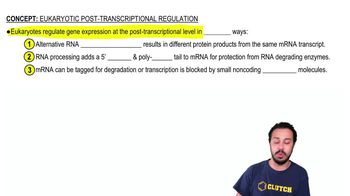
Post-transcriptional processing

Post-transcriptional processing in eukaryotes involves modifications to pre-mRNA, including splicing, capping, and polyadenylation, to produce mature mRNA. This process is crucial because bacterial cells lack the machinery to perform these modifications. Using mRNA and reverse transcriptase allows the creation of cDNA, which bypasses the need for these eukaryotic-specific processes, enabling expression in bacteria.
Video consigliato:
01:56
Eukaryotic Post-Transcriptional Regulation

Reverse transcriptase

Reverse transcriptase is an enzyme that synthesizes complementary DNA (cDNA) from an RNA template. This enzyme is essential in cloning eukaryotic genes into bacteria because it allows the conversion of processed mRNA into cDNA, which can be inserted into bacterial plasmids. This process circumvents the need for eukaryotic post-transcriptional modifications, facilitating gene expression in prokaryotic systems.
Video consigliato:
04:16
1) Initiation of Transcription

Cloning in bacterial cells

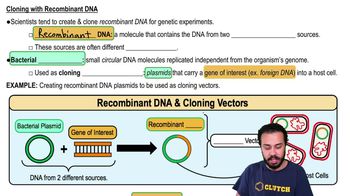
Cloning a eukaryotic gene in bacterial cells involves inserting the gene into a bacterial plasmid, which can replicate independently within the host cell. This process requires overcoming differences in gene expression mechanisms between eukaryotes and prokaryotes, such as the absence of intron splicing in bacteria. Using cDNA derived from mRNA ensures that only the coding sequences are cloned, allowing for successful expression in bacterial systems.
Video consigliato:
03:41
Cloning with Recombinant DNA