Ch. 20 - DNA Tools and Biotechnology
Campbell - Campbell Biology 12th Edition
Urry12th EditionCampbell BiologyISBN: 9785794169850Non è quello che usi tu?Cambia libro di testo
Capitolo 20, Problema 7

Which of the following sequences in double-stranded DNA is most likely to be recognized as a cutting site for a restriction enzyme?
a. AAGG TTCC
b. GGCC CCGG
c. ACCA TGGT
d. AAAA TTTT

Guida verificata passo dopo passo
1
Understand that restriction enzymes recognize specific sequences in DNA, often palindromic sequences, which are the same when read 5' to 3' on both strands.
Examine each option to determine if it is a palindromic sequence. A palindromic sequence reads the same forwards and backwards on complementary strands.
Option a: AAGG TTCC is not palindromic because the sequence does not read the same forwards and backwards.
Option b: GGCC CCGG is palindromic because when you read the sequence 5' to 3' on both strands, it is the same.
Option c: ACCA TGGT and option d: AAAA TTTT are not palindromic. ACCA TGGT does not read the same forwards and backwards, and AAAA TTTT, while symmetrical, is not typically recognized by restriction enzymes.

Risposta video verificata per un problema simile:

Questa soluzione video è stata consigliata dai nostri tutor come utile per risolvere questo problema.
Durata del video:
2m

Concetti chiave

Ecco i concetti essenziali che devi comprendere per rispondere correttamente alla domanda.

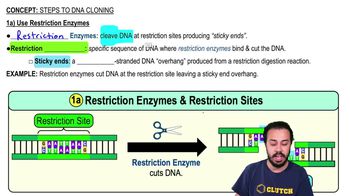
Restriction Enzymes

Restriction enzymes, also known as restriction endonucleases, are proteins that cut DNA at specific sequences. These enzymes recognize short, palindromic DNA sequences, which are the same when read forwards and backwards on complementary strands. They are essential tools in molecular biology for DNA manipulation and cloning.
Video consigliato:
03:27
1a) Use Restriction Enzymes

Palindromic Sequences

A palindromic sequence in DNA is a sequence of nucleotides that reads the same in both directions on complementary strands. For example, the sequence 'GAATTC' is palindromic because its complementary strand is 'CTTAAG', which reads the same in reverse. These sequences are often recognized by restriction enzymes as cutting sites.
Video consigliato:
01:03
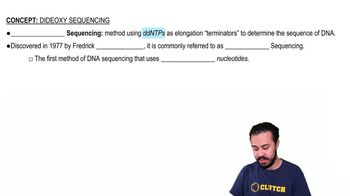
Dideoxy Sequencing

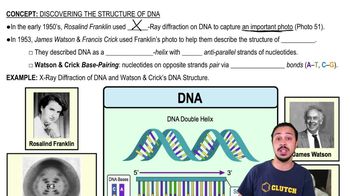
DNA Double Helix Structure

The DNA double helix consists of two complementary strands of nucleotides twisted around each other. Each strand is composed of a sugar-phosphate backbone and nitrogenous bases (adenine, thymine, cytosine, and guanine) that pair specifically (A with T, C with G). Understanding this structure is crucial for identifying palindromic sequences and restriction enzyme sites.
Video consigliato:
04:41
Discovering the Structure of DNA