Ch. 27 - Bacteria and Archaea
Campbell - Campbell Biology 12th Edition
Urry12th EditionCampbell BiologyISBN: 9785794169850Non è quello che usi tu?Cambia libro di testo
Capitolo 27, Problema 1

Genetic variation in bacterial populations cannot result from
a. Transduction
b. Conjugation
c. Mutation
d. Meiosis

Guida verificata passo dopo passo
1
Understand the concept of genetic variation: Genetic variation refers to the differences in DNA sequences among individuals within a population. In bacteria, this variation can arise through several mechanisms.
Review the process of transduction: Transduction is a method of horizontal gene transfer in bacteria where bacteriophages (viruses that infect bacteria) transfer genetic material from one bacterium to another, contributing to genetic variation.
Examine conjugation: Conjugation is another form of horizontal gene transfer where genetic material is directly transferred between bacterial cells through a pilus, leading to genetic variation.
Consider mutation: Mutation is a change in the DNA sequence that can occur spontaneously or due to environmental factors, resulting in genetic variation within bacterial populations.
Understand meiosis: Meiosis is a type of cell division that reduces the chromosome number by half and is involved in sexual reproduction in eukaryotes, not bacteria. Bacteria reproduce asexually through binary fission, so meiosis does not contribute to genetic variation in bacterial populations.

Risposta video verificata per un problema simile:

Questa soluzione video è stata consigliata dai nostri tutor come utile per risolvere questo problema.
Durata del video:
1m

Concetti chiave

Ecco i concetti essenziali che devi comprendere per rispondere correttamente alla domanda.

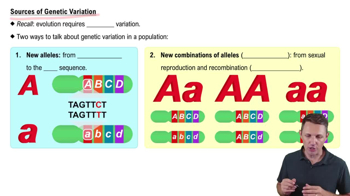
Genetic Variation

Genetic variation refers to the differences in DNA sequences among individuals within a population. In bacteria, this variation can arise through mechanisms such as mutation, conjugation, transduction, and transformation, allowing for adaptation and evolution in changing environments.
Video consigliato:
Percorso guidato
02:16
Sources of Genetic Variation

Meiosis

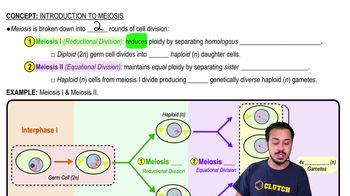
Meiosis is a type of cell division that reduces the chromosome number by half, creating four haploid cells, each genetically distinct from the parent cell. It is a process exclusive to eukaryotic organisms for sexual reproduction, and does not occur in bacteria, which reproduce asexually.
Video consigliato:
04:49
Meiosis I & Meiosis II

Bacterial Reproduction

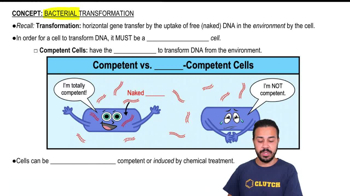
Bacteria primarily reproduce asexually through binary fission, where a single cell divides into two identical daughter cells. Genetic variation in bacteria can occur through horizontal gene transfer methods like conjugation, transduction, and transformation, but not through meiosis.
Video consigliato:
03:06
Bacterial Transformation