Ch. 27 - Bacteria and Archaea
Campbell - Campbell Biology 12th Edition
Urry12th EditionCampbell BiologyISBN: 9785794169850Non è quello che usi tu?Cambia libro di testo
Capitolo 27, Problema 3

Which of the following statements is true?
a. Archaea and bacteria have identical membrane lipids
b. The cell walls of archaea lack peptidoglycan
c. Prokaryotes have low levels of genetic diversity
d. No archaea are capable of using CO₂ to oxidize H₂, releasing methane

Guida verificata passo dopo passo
1
Step 1: Begin by analyzing the structure and composition of membrane lipids in archaea and bacteria. Archaea have unique membrane lipids composed of ether linkages, while bacteria have membrane lipids with ester linkages. This makes statement 'a' incorrect.
Step 2: Examine the composition of cell walls in archaea. Unlike bacteria, archaea lack peptidoglycan in their cell walls and instead have pseudopeptidoglycan or other polymers. This makes statement 'b' correct.
Step 3: Evaluate the genetic diversity of prokaryotes. Prokaryotes, including archaea and bacteria, exhibit high levels of genetic diversity due to mechanisms like horizontal gene transfer, mutations, and rapid reproduction. This makes statement 'c' incorrect.
Step 4: Investigate the metabolic capabilities of archaea. Some archaea, such as methanogens, are capable of using CO2 to oxidize H2, releasing methane as a byproduct. This makes statement 'd' incorrect.
Step 5: Conclude that the correct answer is statement 'b', based on the analysis of cell wall composition in archaea.

Risposta video verificata per un problema simile:

Questa soluzione video è stata consigliata dai nostri tutor come utile per risolvere questo problema.
Durata del video:
1m

Concetti chiave

Ecco i concetti essenziali che devi comprendere per rispondere correttamente alla domanda.

Differences between Archaea and Bacteria

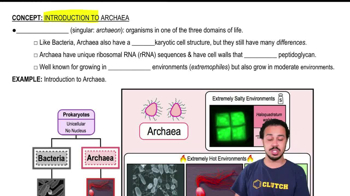
Archaea and bacteria are both prokaryotic organisms, but they differ significantly in their cellular structures and biochemistry. For instance, the membrane lipids of archaea contain ether bonds, while bacteria have ester bonds. Additionally, the composition of their cell walls varies, with archaea lacking peptidoglycan, a key component found in bacterial cell walls.
Video consigliato:
04:39
Introduction to Archaea

Prokaryotic Cell Walls

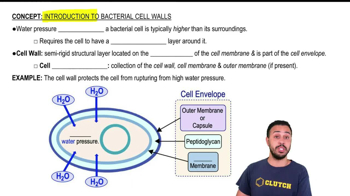
Prokaryotic organisms, including bacteria and archaea, have distinct cell wall structures that provide shape and protection. While bacterial cell walls are primarily composed of peptidoglycan, archaeal cell walls can be made of various materials, such as pseudopeptidoglycan or proteins, and do not contain peptidoglycan at all. This difference is crucial for understanding the classification and characteristics of these organisms.
Video consigliato:
03:44
Introduction to Bacterial Cell Walls

Genetic Diversity in Prokaryotes

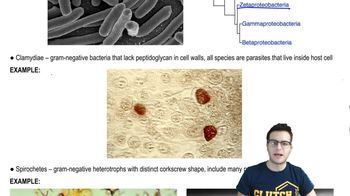
Prokaryotes, which include both bacteria and archaea, exhibit a high level of genetic diversity despite their simple structure. This diversity arises from mechanisms such as horizontal gene transfer, mutations, and rapid reproduction rates. Contrary to the statement in the question, prokaryotes are known for their adaptability and genetic variation, which can lead to significant evolutionary changes.
Video consigliato:
03:51
Prokaryote Lineages 1