Ch. 33 - An introduction to Invertebrates
Campbell - Campbell Biology 12th Edition
Urry12th EditionCampbell BiologyISBN: 9785794169850Non è quello che usi tu?Cambia libro di testo
Capitolo 33, Problema 1

A land snail, a clam, and an octopus all share
a. A mantle
b. A radula
c. Gills
d. Distinct cephalization

Guida verificata passo dopo passo
1
Begin by identifying the common phylum to which a land snail, a clam, and an octopus belong. All three are part of the phylum Mollusca.
Understand the characteristics of the phylum Mollusca. Members of this phylum typically have a mantle, which is a significant part of their anatomy.
Consider the function of the mantle in mollusks. The mantle is a layer of tissue that covers the body and is responsible for secreting the shell in many mollusks.
Evaluate the other options provided: a radula is a specialized feeding organ found in some mollusks, but not all (e.g., clams do not have a radula). Gills are present in aquatic mollusks, but not in land snails. Distinct cephalization refers to the development of a head region, which is more pronounced in octopuses than in snails or clams.
Conclude that the shared feature among a land snail, a clam, and an octopus is the mantle, as it is a defining characteristic of the phylum Mollusca.

Risposta video verificata per un problema simile:

Questa soluzione video è stata consigliata dai nostri tutor come utile per risolvere questo problema.
Durata del video:
54s

Concetti chiave

Ecco i concetti essenziali che devi comprendere per rispondere correttamente alla domanda.

Mantle

The mantle is a significant part of mollusks, including snails, clams, and octopuses. It is a layer of tissue that covers the visceral mass and is responsible for secreting the shell in those mollusks that have one. The mantle also plays a role in respiration and excretion, making it a crucial anatomical feature across different mollusk species.
Video consigliato:
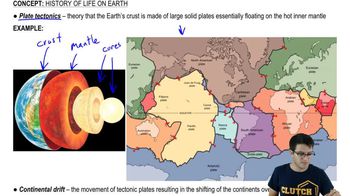
04:33
Plate Tectonics and Continental Drift

Radula

A radula is a specialized feeding organ found in most mollusks, except bivalves like clams. It is a ribbon-like structure covered with tiny teeth used to scrape or cut food before ingestion. The presence or absence of a radula is a key distinguishing feature among mollusk classes, highlighting differences in feeding strategies.
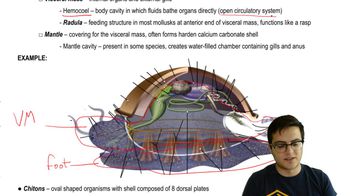
Video consigliato:
06:30
Mollusks

Cephalization

Cephalization refers to the concentration of sensory organs and nerve cells at the anterior end of an organism, forming a head region. This feature is prominent in octopuses, which have a well-developed head and brain, but is less distinct in snails and clams. Cephalization is associated with increased complexity and specialization in the nervous system, enhancing an organism's ability to interact with its environment.
Video consigliato:
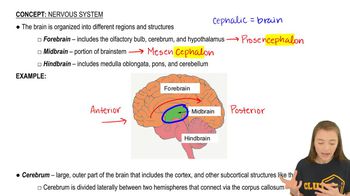
11:10
Cerebrum and Cerebral Cortex