Ch. 33 - An introduction to Invertebrates
Campbell - Campbell Biology 12th Edition
Urry12th EditionCampbell BiologyISBN: 9785794169850Non è quello che usi tu?Cambia libro di testo
Capitolo 33, Problema 6

In Figure 33.7, assume that the two medusae shown at step 4 were produced by one polyp colony. Review Concept 12.1 and Concept 13.3, and then use your understanding of mitosis and meiosis to select which of the following is true.
a. Both the medusae and the gametes are genetically identical.
b. Neither the medusae nor the gametes are genetically identical.
c. The medusae are not genetically identical but the gametes are genetically identical.
d. The medusae are genetically identical but the gametes differ genetically.

Guida verificata passo dopo passo
1
Review Concept 12.1, which covers mitosis, a process where a single cell divides to produce two genetically identical daughter cells. This is important for understanding how the medusae could be genetically identical if they are produced by mitosis.
Review Concept 13.3, which covers meiosis, a process that results in four genetically diverse gametes. This is crucial for understanding how gametes can differ genetically.
Consider the life cycle of cnidarians, which includes both a polyp stage and a medusa stage. The medusae are typically produced asexually from the polyp colony through mitosis, leading to genetic identicality.
Understand that gametes are produced through meiosis, which involves genetic recombination and results in genetically diverse gametes.
Based on the understanding of mitosis and meiosis, determine which statement is true: (A) Both the medusae and the gametes are genetically identical, (B) Neither the medusae nor the gametes are genetically identical, (C) The medusae are not genetically identical but the gametes are genetically identical, or (D) The medusae are genetically identical but the gametes differ genetically.

Risposta video verificata per un problema simile:

Questa soluzione video è stata consigliata dai nostri tutor come utile per risolvere questo problema.
Durata del video:
4m

Concetti chiave

Ecco i concetti essenziali che devi comprendere per rispondere correttamente alla domanda.

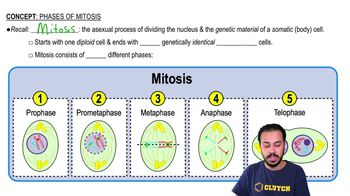
Mitosis

Mitosis is a type of cell division that results in two daughter cells, each having the same number and kind of chromosomes as the parent nucleus. It is essential for growth, repair, and asexual reproduction in organisms. In the context of the question, mitosis would be responsible for producing genetically identical medusae from a single polyp colony.
Video consigliato:
03:21
Phases of Mitosis

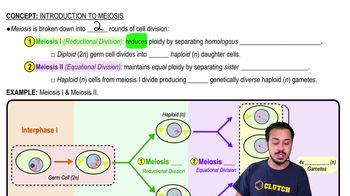
Meiosis

Meiosis is a specialized form of cell division that reduces the chromosome number by half, resulting in four genetically diverse gametes. This process is crucial for sexual reproduction and genetic diversity. In the scenario described, meiosis would lead to the production of gametes that are not genetically identical, contributing to genetic variation.
Video consigliato:
04:49
Meiosis I & Meiosis II

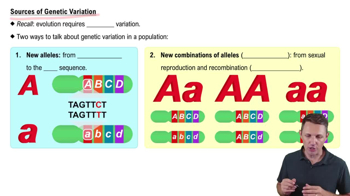
Genetic Variation

Genetic variation refers to the differences in DNA sequences among individuals within a population. It is a result of processes like meiosis, which includes crossing over and independent assortment. In the context of the question, understanding genetic variation helps explain why gametes produced through meiosis are not genetically identical, unlike the medusae produced through mitosis.
Video consigliato:
Percorso guidato
02:16
Sources of Genetic Variation