Ch. 33 - An introduction to Invertebrates
Campbell - Campbell Biology 12th Edition
Urry12th EditionCampbell BiologyISBN: 9785794169850Non è quello che usi tu?Cambia libro di testo
Capitolo 33, Problema 4

Which of the following combinations of phylum and description is correct?
a. Echinodermata—radial symmetry as a larva, coelom
b. Nematoda—roundworms, internal skeleton
c. Platyhelminthes—flatworms, gastrovascular cavity, no body cavity
d. Porifera—gastrovascular cavity, coelom

Guida verificata passo dopo passo
1
Step 1: Understand the question. The problem asks to identify the correct combination of a phylum and its description. Each option pairs a phylum with specific characteristics. We need to evaluate each option based on biological knowledge of these phyla.
Step 2: Analyze option (A) - Echinodermata. Echinoderms (e.g., sea stars) exhibit bilateral symmetry as larvae and radial symmetry as adults. They also have a coelom, which is a body cavity. This description is partially correct, but note the symmetry changes during development.
Step 3: Analyze option (B) - Nematoda. Nematodes (roundworms) are pseudocoelomates, meaning they have a body cavity that is not fully lined with mesoderm. They do not have an internal skeleton; instead, they have a hydrostatic skeleton. This description is incorrect.
Step 4: Analyze option (C) - Platyhelminthes. Flatworms are acoelomates, meaning they lack a body cavity. They have a gastrovascular cavity for digestion. This description is correct as it matches the characteristics of Platyhelminthes.
Step 5: Analyze option (D) - Porifera. Sponges (Porifera) lack a gastrovascular cavity and a coelom. They rely on water flow through their porous bodies for nutrient and waste exchange. This description is incorrect. Based on the analysis, option (C) is the correct combination.

Risposta video verificata per un problema simile:

Questa soluzione video è stata consigliata dai nostri tutor come utile per risolvere questo problema.
Durata del video:
3m

Concetti chiave

Ecco i concetti essenziali che devi comprendere per rispondere correttamente alla domanda.

Echinodermata

Echinodermata is a phylum of marine animals characterized by radial symmetry in adults and bilateral symmetry in larvae. They possess a coelom, which is a fluid-filled body cavity, and are known for their unique water vascular system that aids in movement and feeding. Common examples include starfish and sea urchins.

Nematoda

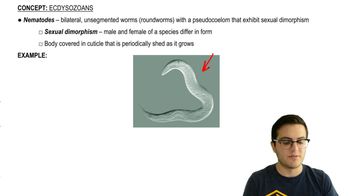
Nematoda, or roundworms, are a phylum of unsegmented worms that have a complete digestive system and a pseudocoelom, which is a body cavity not entirely lined by mesoderm. They lack an internal skeleton and are found in various environments, including soil and aquatic habitats. Many nematodes are important in ecosystems and some are parasitic.
Video consigliato:
02:05
Nematodes

Platyhelminthes

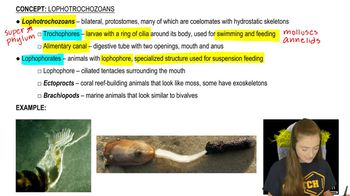
Platyhelminthes, commonly known as flatworms, are a phylum of soft-bodied invertebrates that exhibit bilateral symmetry and are characterized by their flattened bodies. They possess a gastrovascular cavity, which serves both digestive and circulatory functions, but lack a true coelom. Examples include planarians, flukes, and tapeworms.
Video consigliato:
11:32
Lophotrochozoans