Ch. 44 - Osmoregulation and Excretion
Campbell - Campbell Biology 12th Edition
Urry12th EditionCampbell BiologyISBN: 9785794169850Non è quello che usi tu?Cambia libro di testo
Capitolo 44, Problema 2

Which process in the nephron is least selective?
a. Filtration
b. Reabsorption
c. Active transport
d. Secretion

Guida verificata passo dopo passo
1
Understand the function of the nephron: The nephron is the functional unit of the kidney, responsible for filtering blood and forming urine. It involves several processes: filtration, reabsorption, secretion, and excretion.
Define filtration: Filtration occurs in the glomerulus, where blood pressure forces water and solutes out of the blood and into the Bowman's capsule. This process is largely non-selective, as it allows many small molecules to pass through, regardless of their utility to the body.
Define reabsorption: Reabsorption is the process by which useful substances such as glucose, amino acids, and ions are reabsorbed from the filtrate back into the blood. This process is highly selective, as it involves specific transport proteins.
Define active transport: Active transport is a selective process that requires energy to move substances against their concentration gradient. It is used in the nephron to reabsorb ions and other molecules.
Define secretion: Secretion involves the active transport of additional waste products from the blood into the nephron tubule. This process is also selective, targeting specific substances for excretion.

Risposta video verificata per un problema simile:

Questa soluzione video è stata consigliata dai nostri tutor come utile per risolvere questo problema.
Durata del video:
3m

Concetti chiave

Ecco i concetti essenziali che devi comprendere per rispondere correttamente alla domanda.

Filtration in the Nephron

Filtration is the process by which blood plasma is filtered through the glomerulus into the Bowman's capsule in the nephron. It is a non-selective process driven by blood pressure, allowing water, ions, and small molecules to pass while retaining larger molecules like proteins and cells. This initial step forms the filtrate, which will undergo further processing in the nephron.
Video consigliato:
02:59
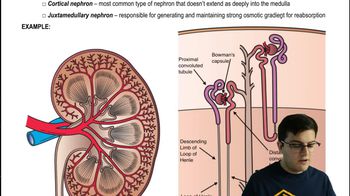
Kidney and Nephron

Reabsorption in the Nephron

Reabsorption is a selective process where essential substances such as glucose, amino acids, and ions are transported from the filtrate back into the blood. This occurs primarily in the proximal convoluted tubule and involves both passive and active transport mechanisms, ensuring that valuable nutrients and water are conserved while waste products remain in the filtrate.
Video consigliato:
02:59
Kidney and Nephron

Secretion in the Nephron

Secretion is the active transport of additional waste products and excess ions from the blood into the nephron tubule. This process occurs mainly in the distal convoluted tubule and collecting duct, allowing the body to fine-tune the composition of urine by removing substances like hydrogen ions, potassium ions, and certain drugs, thus maintaining homeostasis.
Video consigliato:
01:34
Protein Secretion