

Ch. 54 - Community Ecology
Campbell - Campbell Biology 12th Edition
Urry12th EditionCampbell BiologyISBN: 9785794169850Non è quello che usi tu?Cambia libro di testo
Capitolo 54, Problema 6

Food chains are sometimes short because
a. Only a single species of herbivore feeds on each plant species.
b. Local extinction of a species causes extinction of the other species in its food chain.
c. Most of the energy in a trophic level is lost as energy passes to the next higher level.
d. Most producers are inedible.

Guida verificata passo dopo passo
1
Understand the concept of a food chain: A food chain is a linear sequence of organisms where nutrients and energy pass as one organism eats another.
Recognize the role of energy transfer in food chains: Energy is transferred from one trophic level to the next, but not all energy is efficiently passed on.
Learn about energy loss in trophic levels: As energy moves from one trophic level to the next, a significant portion is lost, primarily as heat due to metabolic processes.
Consider the implications of energy loss: Because of this energy loss, food chains tend to be short, as there is less energy available to support higher trophic levels.
Evaluate the options given in the problem: Option c, which states that most of the energy in a trophic level is lost as energy passes to the next higher level, aligns with the concept of energy loss limiting the length of food chains.

Risposta video verificata per un problema simile:

Questa soluzione video è stata consigliata dai nostri tutor come utile per risolvere questo problema.
Durata del video:
2m

Concetti chiave

Ecco i concetti essenziali che devi comprendere per rispondere correttamente alla domanda.

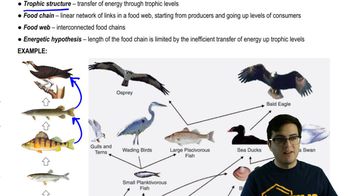
Trophic Levels

Trophic levels represent the hierarchical stages in a food chain, starting with producers and moving up to various levels of consumers. Each level is defined by how organisms obtain energy, with producers like plants at the base, followed by herbivores, and then carnivores. Understanding trophic levels is crucial for analyzing energy flow and species interactions within ecosystems.
Video consigliato:
03:14
Trophic Structure

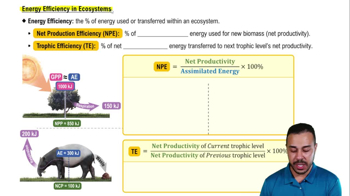
Energy Transfer Efficiency

Energy transfer efficiency refers to the percentage of energy that is passed from one trophic level to the next. Typically, only about 10% of the energy is transferred, while the rest is lost as heat or used in metabolic processes. This inefficiency limits the number of trophic levels in a food chain, as less energy is available to support higher-level consumers.
Video consigliato:
06:28
Energy Efficiency in Ecosystems

Local Extinction

Local extinction occurs when a species disappears from a particular area, affecting the food chain and ecosystem dynamics. The loss of a species can lead to cascading effects, potentially causing the extinction of dependent species. Understanding local extinction helps explain the fragility and interconnectedness of food chains and the importance of biodiversity for ecosystem stability.
Video consigliato:
Pratica correlata
Domanda del libro di testo

Which of the following could qualify as a top-down control on a grassland community?

a. Limitation of plant biomass by rainfall amount

b. Influence of temperature on competition among plants

c. Influence of soil nutrients on the abundance of grasses versus wildflowers

d. Effect of grazing intensity by bison on plant species diversity

1173
views
Domanda del libro di testo

According to the island equilibrium model, species richness would be greatest on an island that is

a. Large and remote

b. Small and remote

c. Large and close to a mainland

d. Small and close to a mainland

1098
views
Domanda del libro di testo

Community 1 contains 100 individuals distributed among four species: 5A, 5B, 85C, and 5D. Community 2 contains 100 individuals distributed among three species: 30A, 40B, and 30C. Calculate the Shannon diversity (H) for each community. Which community is more diverse?

1727
views
Domanda del libro di testo

Predators that are keystone species can maintain species diversity in a community if they

a. Competitively exclude other predators

b. Prey on the community's dominant species

c. Reduce the number of disruptions in the community

d. Prey only on the least abundant species in the community

1778
views
Domanda del libro di testo

Based on the intermediate disturbance hypothesis, a community's species diversity is increased by

a. Frequent massive disturbance

b. Stable conditions with no disturbance

c. Moderate levels of disturbance

d. Human intervention to eliminate disturbance

1488
views
Domanda del libro di testo

The most plausible hypothesis to explain why species richness is higher in tropical than in temperate regions is that

a. Tropical communities are younger.

b. Tropical regions generally have more available water and higher levels of solar radiation.

c. Higher temperatures cause more rapid speciation.

d. Diversity increases as evapotranspiration decreases.

1451
views