
Ch. 9 - Cellular Respiration and Fermentation
Campbell - Campbell Biology 12th Edition
Urry12th EditionCampbell BiologyISBN: 9785794169850Non è quello che usi tu?Cambia libro di testo
Capitolo 9, Problema 2

Which metabolic pathway is common to both fermentation and cellular respiration of a glucose molecule?
a. The citric acid cycle
b. The electron transport chain
c. Glycolysis
d. Reduction of pyruvate to lactate

Guida verificata passo dopo passo
1
Begin by understanding the two processes: fermentation and cellular respiration. Both are metabolic pathways that cells use to generate energy from glucose.
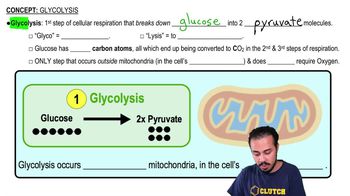
Identify the key stages of cellular respiration: glycolysis, the citric acid cycle, and the electron transport chain. Glycolysis is the first step, where glucose is broken down into pyruvate.
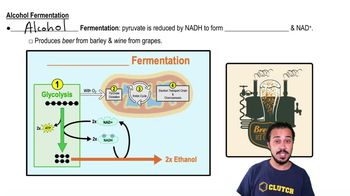
Recognize that fermentation is an anaerobic process that also begins with glycolysis, where glucose is converted into pyruvate, but does not proceed to the citric acid cycle or electron transport chain.
Note that glycolysis is the initial step in both fermentation and cellular respiration, making it common to both pathways. It occurs in the cytoplasm and does not require oxygen.
Conclude that glycolysis is the metabolic pathway shared by both fermentation and cellular respiration, as it is the process that breaks down glucose into pyruvate in both pathways.

Risposta video verificata per un problema simile:

Questa soluzione video è stata consigliata dai nostri tutor come utile per risolvere questo problema.
Durata del video:
49s

Concetti chiave

Ecco i concetti essenziali che devi comprendere per rispondere correttamente alla domanda.

Glycolysis

Glycolysis is the metabolic pathway that breaks down glucose into pyruvate, yielding ATP and NADH. It occurs in the cytoplasm and is the first step in both fermentation and cellular respiration, making it common to both processes. Glycolysis does not require oxygen, allowing it to function in anaerobic conditions.
Video consigliato:
05:04
Glycolysis

Fermentation

Fermentation is an anaerobic process that allows cells to generate energy without oxygen. It follows glycolysis and converts pyruvate into either lactic acid or ethanol, depending on the organism. This process regenerates NAD+, enabling glycolysis to continue producing ATP in the absence of oxygen.
Video consigliato:
02:02
Alcohol Fermentation

Cellular Respiration

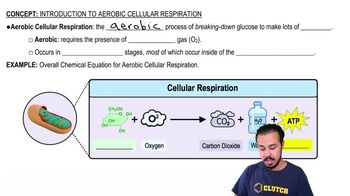
Cellular respiration is a series of metabolic processes that convert biochemical energy from nutrients into ATP, using oxygen. It includes glycolysis, the citric acid cycle, and the electron transport chain. Cellular respiration is more efficient than fermentation, producing significantly more ATP per glucose molecule.
Video consigliato:
03:39
Introduction to Cellular Respiration