Ch. 16 - How Genes Work
Freeman - Biological Science 8th Edition
Freeman8th EditionBiological ScienceISBN: 9780138276263Non è quello che usi tu?Cambia libro di testo
Capitolo 16, Problema 4

Which of the following describes the experimental strategy that was used to decipher the genetic code?
a. Comparing the amino acid sequences of proteins with the base sequence of their genes
b. Analyzing the sequence of RNAs produced from known DNA sequences
c. Analyzing mutants that changed the code
d. Examining the polypeptides produced when RNAs with particular sequences were translated

Guida verificata passo dopo passo
1
Understand the question: The problem is asking about the experimental strategy used to decipher the genetic code, which refers to the process of determining how sequences of nucleotides in RNA correspond to specific amino acids in proteins.
Recall the historical context: The genetic code was deciphered through experiments that involved synthesizing RNA molecules with known sequences and observing the resulting polypeptides (chains of amino acids) produced during translation.
Eliminate incorrect options: a) Comparing amino acid sequences with gene sequences was not the primary method used to decipher the genetic code. b) Analyzing RNA sequences from DNA does not directly reveal the correspondence between codons and amino acids. c) Studying mutants can provide insights into gene function but was not the main strategy for decoding the genetic code.
Focus on the correct approach: d) The correct strategy involved creating synthetic RNAs with specific sequences and translating them in a controlled environment to observe the resulting polypeptides. This allowed researchers to match RNA codons to their corresponding amino acids.
Conclude: The experimental strategy described in option d aligns with the historical experiments conducted by scientists like Nirenberg and Khorana, who used synthetic RNAs to systematically decode the genetic code.

Risposta video verificata per un problema simile:

Questa soluzione video è stata consigliata dai nostri tutor come utile per risolvere questo problema.
Durata del video:
2m

Concetti chiave

Ecco i concetti essenziali che devi comprendere per rispondere correttamente alla domanda.

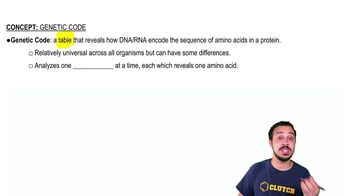
Genetic Code

The genetic code is the set of rules by which information encoded in genetic material (DNA or RNA) is translated into proteins. It consists of codons, which are sequences of three nucleotides that correspond to specific amino acids. Understanding the genetic code is essential for deciphering how genes dictate the synthesis of proteins, which are crucial for cellular functions.
Video consigliato:
01:28
Genetic Code

Transcription and Translation

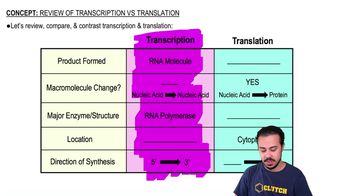
Transcription is the process by which the information in a DNA sequence is copied into messenger RNA (mRNA), while translation is the subsequent process where ribosomes synthesize proteins based on the sequence of the mRNA. These two processes are fundamental to gene expression and are key to understanding how genetic information is converted into functional products.
Video consigliato:
04:07
Review of Transcription vs. Translation

Mutagenesis

Mutagenesis refers to the process of inducing changes or mutations in the DNA sequence, which can lead to alterations in the genetic code. Analyzing mutants helps researchers understand the relationship between specific genetic sequences and their corresponding phenotypes, providing insights into how the genetic code operates and how it can be deciphered through experimental strategies.
Pratica correlata
Domanda del libro di testo

A friend says, 'Geneticists spend all their time talking about DNA, but that's silly because DNA really isn't that important in the functions of a cell.' In what ways is she right, and in what ways might she be wrong?

1163
views
Domanda del libro di testo

Which of the following describes mutations? Select True or False for each statement.

T/F Point mutations can occur in any DNA sequence.

T/F Frameshift mutations can occur in any DNA sequence.

T/F Neutral mutations depend on the degeneracy of the genetic code.

T/F Deleterious mutations occur only in protein-coding sequences of DNA.

810
views
Domanda del libro di testo

A minimal genetic code requires only 21 codons—one for each amino acid, and one for a stop signal. Given this, what advantage might be offered by having a code with 64 codons?

1187
views
Domanda del libro di testo

DNA's primary structure is made up of just four different bases, and its secondary structure is regular and highly stable. How can a molecule with these characteristics hold the information required to build and maintain a cell?

1574
views
Domanda del libro di testo

If a base-pair change occurs in DNA, this a. is a mutation. b. would be a mutation only if it falls in a protein-coding part of a gene. c. would be a mutation only if it falls in a transcribed part of the genome. d. is not a mutation, because only one base pair has been altered.

858
views
Domanda del libro di testo

Which of the following is an important exception to the central dogma of molecular biology?

a. Many genes code for RNAs that function directly in the cell.

b. DNA is the repository of genetic information in all cells.

c. Messenger RNA is a short-lived 'information carrier.

d. Proteins are responsible for most aspects of the phenotype.

3346
views