
Ch. 25 - Phylogenies and the History of Life
Freeman - Biological Science 8th Edition
Freeman8th EditionBiological ScienceISBN: 9780138276263Non è quello che usi tu?Cambia libro di testo
Capitolo 25, Problema 5

What important assumption does parsimony make when assessing which phylogenetic tree is most accurate? Why was parsimony misleading in the case of the astragalus during the evolution of artiodactyls?

Guida verificata passo dopo passo
1
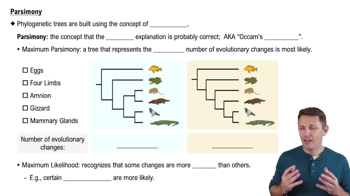
Parsimony assumes that the phylogenetic tree that requires the fewest evolutionary changes is the most likely to be accurate. This principle is based on the idea that simpler explanations, requiring fewer changes, are preferable.
The assumption of parsimony can be misleading if convergent evolution or evolutionary reversals occur. These phenomena can lead to similar traits evolving independently in different lineages, which can be misinterpreted as shared ancestry.
In the case of the astragalus bone during the evolution of artiodactyls, parsimony was misleading because it failed to account for convergent evolution. The astragalus bone evolved similar morphological traits in different groups of artiodactyls independently.
The misleading result from using parsimony in this case led to incorrect assumptions about the relationships between different artiodactyl groups. It suggested a closer relationship between groups that independently evolved similar astragalus traits, rather than their true evolutionary relationships.
To avoid such issues, other methods like maximum likelihood or Bayesian inference, which consider the probability of evolutionary changes and can incorporate more complex models of evolution, are often used alongside or instead of parsimony.

Risposta video verificata per un problema simile:

Questa soluzione video è stata consigliata dai nostri tutor come utile per risolvere questo problema.
Durata del video:
5m

Concetti chiave

Ecco i concetti essenziali che devi comprendere per rispondere correttamente alla domanda.

Parsimony Principle

The parsimony principle in phylogenetics assumes that the simplest explanation, or the tree with the least number of evolutionary changes, is the most likely to be correct. This approach minimizes the complexity of evolutionary pathways by favoring trees that require fewer character state changes, thus providing a straightforward method for inferring relationships among species.
Video consigliato:

Phylogenetic Trees

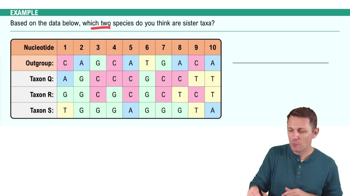
Phylogenetic trees are graphical representations that depict the evolutionary relationships among various biological species based on their genetic or phenotypic characteristics. These trees illustrate how species diverged from common ancestors over time, allowing researchers to visualize and analyze evolutionary history and lineage.
Video consigliato:
Percorso guidato
04:13
Building Phylogenetic Trees Example 2

Convergent Evolution

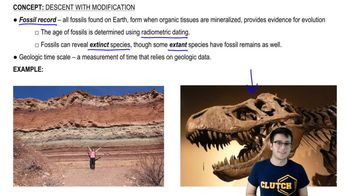
Convergent evolution occurs when unrelated species evolve similar traits or adaptations in response to similar environmental pressures, rather than from a common ancestor. This phenomenon can mislead phylogenetic analyses, such as in the case of the astragalus in artiodactyls, where similar adaptations may be incorrectly interpreted as evidence of close evolutionary relationships.
Video consigliato:
05:22
Convergent and Divergent Evolution