
Ch. 25 - Phylogenies and the History of Life
Freeman - Biological Science 8th Edition
Freeman8th EditionBiological ScienceISBN: 9780138276263Non è quello che usi tu?Cambia libro di testo
Capitolo 25, Problema 8

Use the fossil evidence shown in Figure 25.6 to determine whether flight evolved earlier in insects or in birds. Is flight an example of homology or convergent evolution? Explain.

Guida verificata passo dopo passo
1
Examine the timeline in the image to identify the first appearance of flight in insects and birds. The timeline is divided into geological periods and epochs, with key evolutionary events marked.
Locate the 'First winged insects' event on the timeline. It appears in the Devonian period, which is approximately 419 to 359 million years ago.
Next, find the 'First bird-like reptile' event, which is marked in the Jurassic period, approximately 201 to 145 million years ago.
Compare the two events: 'First winged insects' in the Devonian period occurred earlier than 'First bird-like reptile' in the Jurassic period, indicating that flight evolved earlier in insects than in birds.
Discuss whether flight in insects and birds is an example of homology or convergent evolution. Homology refers to traits inherited from a common ancestor, while convergent evolution refers to similar traits evolving independently in different lineages. Since insects and birds do not share a common ancestor with flight capabilities, flight is an example of convergent evolution.

Risposta video verificata per un problema simile:

Questa soluzione video è stata consigliata dai nostri tutor come utile per risolvere questo problema.
Durata del video:
1m

Concetti chiave

Ecco i concetti essenziali che devi comprendere per rispondere correttamente alla domanda.

Fossil Evidence

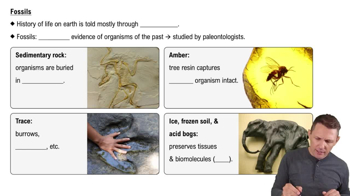
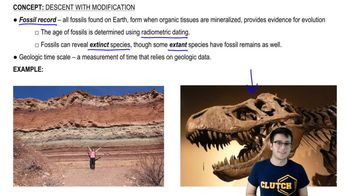
Fossil evidence refers to the preserved remains or traces of organisms from the past, which provide crucial insights into the evolutionary history of species. In the context of flight evolution, analyzing fossils can help determine the timeline and anatomical features associated with the development of flight in different groups, such as insects and birds.
Video consigliato:

Homology vs. Convergent Evolution

Homology refers to traits that are similar due to shared ancestry, while convergent evolution describes the independent evolution of similar traits in different lineages due to similar environmental pressures. Understanding whether flight in insects and birds is homologous or a result of convergent evolution is essential for interpreting their evolutionary paths and adaptations.
Video consigliato:
05:22
Convergent and Divergent Evolution

Evolution of Flight

The evolution of flight involves various adaptations that allow organisms to take to the air, including changes in body structure, muscle development, and wing formation. Insects and birds represent two distinct evolutionary pathways to flight, and examining their anatomical features and fossil records can reveal the timing and nature of these adaptations.
Video consigliato:
Percorso guidato
05:14
Introduction to Evolution of Populations
Pratica correlata
Domanda del libro di testo

The vast majority of animals that ever existed are now extinct, but Tereza Jezkova and John Wiens wondered which variables were most important in driving the diversification of species that exist today. Why are there so many species in some phyla, such as Cnidaria, but so few in others, such as Ctenophora? Based on your reading of this chapter, propose at least five traits that you think might have been most important in triggering diversification within phyla (examples: origin of hearing, origin of internal fertilization).

754
views
Domanda del libro di testo

What important assumption does parsimony make when assessing which phylogenetic tree is most accurate? Why was parsimony misleading in the case of the astragalus during the evolution of artiodactyls?

964
views
Domanda del libro di testo

The vast majority of animals that ever existed are now extinct, but Tereza Jezkova and John Wiens wondered which variables were most important in driving the diversification of species that exist today. Why are there so many species in some phyla, such as Cnidaria (see photo), but so few in others, such as Ctenophora? A sample of Jekova and Wiens' results is shown here. The R2 value represents the strength of the correlation (where 0.00 is lowest and 1.00 is highest). The P value represents the statistical significance. Which five traits look most important?

628
views
Domanda del libro di testo

The vast majority of animals that ever existed are now extinct, but Tereza Jezkova and John Wiens wondered which variables were most important in driving the diversification of species that exist today. Why are there so many species in some phyla, such as Cnidaria (see photo), but so few in others, such as Ctenophora? Jezkova and Wiens used a type of graph called a linear regression to find correlations between variables such as the proportion of species per phylum with legs (on the y-axis) and the diversification rate per phylum (on the x-axis). Sketch a graph to show what a strong positive correlation between these two variables would look like and what the absence of a correlation would look like.

639
views
Domanda del libro di testo

You can use a 'one-snip test' to identify monophyletic groups—meaning that if you 'cut' any branch on a tree, everything that 'falls off' is a monophyletic group. Why is this valid?

2176
views