Ch. 25 - Phylogenies and the History of Life
Freeman - Biological Science 8th Edition
Freeman8th EditionBiological ScienceISBN: 9780138276263Non è quello che usi tu?Cambia libro di testo
Capitolo 25, Problema 6

You can use a 'one-snip test' to identify monophyletic groups—meaning that if you 'cut' any branch on a tree, everything that 'falls off' is a monophyletic group. Why is this valid?

Guida verificata passo dopo passo
1
Understand the concept of a monophyletic group, which includes an ancestor and all of its descendants. This group shares a common evolutionary history and unique genetic traits that distinguish them from other organisms.
Visualize the phylogenetic tree, where each branch represents a lineage and each node represents a common ancestor. The entire tree is a graphical representation of evolutionary relationships.
Recognize that cutting a branch on the phylogenetic tree isolates a segment of the tree. This segment represents a common ancestor and all its descendants, which is the definition of a monophyletic group.
Realize that the 'one-snip test' is valid because it ensures that all organisms in the isolated segment share a most recent common ancestor, without including any organisms that do not share this ancestor. This is the essence of a monophyletic group.
Apply this understanding to identify monophyletic groups in any phylogenetic tree by imagining or drawing a single cut that would isolate a group of organisms along with their common ancestor.

Risposta video verificata per un problema simile:

Questa soluzione video è stata consigliata dai nostri tutor come utile per risolvere questo problema.
Durata del video:
1m

Concetti chiave

Ecco i concetti essenziali che devi comprendere per rispondere correttamente alla domanda.

Monophyletic Groups

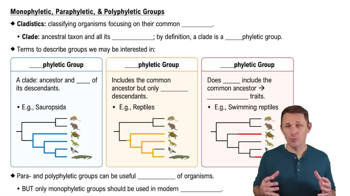
Monophyletic groups, or clades, consist of an ancestor and all its descendants. This concept is fundamental in phylogenetics, as it helps classify organisms based on shared evolutionary history. Identifying monophyletic groups allows scientists to understand evolutionary relationships and the lineage of species.
Video consigliato:
Percorso guidato
06:37
Monophyletic, Paraphyletic, & Polyphyletic Group

Phylogenetic Trees

Phylogenetic trees are diagrams that represent evolutionary relationships among various biological species based on similarities and differences in their physical or genetic characteristics. Each branch point represents a common ancestor, and the structure of the tree illustrates how species diverged over time, making it a crucial tool for visualizing monophyletic groups.
Video consigliato:
Percorso guidato
04:13
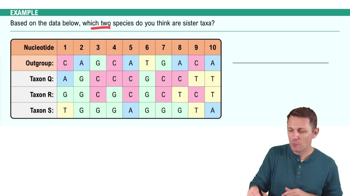
Building Phylogenetic Trees Example 2

One-Snip Test

The one-snip test is a method used to determine if a group of organisms is monophyletic by 'cutting' a branch on a phylogenetic tree. If all the organisms that fall off the branch share a common ancestor and include all descendants, the group is monophyletic. This test is a practical way to assess the validity of taxonomic classifications.
Video consigliato:
03:02
Test Crosses
Pratica correlata
Domanda del libro di testo

The vast majority of animals that ever existed are now extinct, but Tereza Jezkova and John Wiens wondered which variables were most important in driving the diversification of species that exist today. Why are there so many species in some phyla, such as Cnidaria, but so few in others, such as Ctenophora? Based on your reading of this chapter, propose at least five traits that you think might have been most important in triggering diversification within phyla (examples: origin of hearing, origin of internal fertilization).

754
views
Domanda del libro di testo

What important assumption does parsimony make when assessing which phylogenetic tree is most accurate? Why was parsimony misleading in the case of the astragalus during the evolution of artiodactyls?

964
views
Domanda del libro di testo

Which of the following best characterizes an adaptive radiation?

a. Descendant species occupy a large geographic area.

b. A single lineage diversifies rapidly, and descendant species occupy many habitats and ecological roles.

c. Natural selection is particularly intense, because disruptive selection occurs.

d. Species recover after a mass extinction.

771
views
Domanda del libro di testo

Use the fossil evidence shown in Figure 25.6 to determine whether flight evolved earlier in insects or in birds. Is flight an example of homology or convergent evolution? Explain.

708
views
Domanda del libro di testo

Which of the following is an example of homoplasy?

a. Hair in humans and fur in mice

b. Astragalus ankle bones in hippos and deer

c. Hox genes in humans and flies

d. Streamlined bodies in dolphins and ichthyosaurs

1095
views