Ch. 9 - Cellular Respiration and Fermentation
Freeman - Biological Science 8th Edition
Freeman8th EditionBiological ScienceISBN: 9780138276263Non è quello che usi tu?Cambia libro di testo
Capitolo 9, Problema 3

After glucose is fully oxidized by glycolysis, pyruvate processing, and the citric acid cycle, where is most of its energy stored?

Guida verificata passo dopo passo
1
Identify the main stages of glucose oxidation: Glycolysis, Pyruvate Processing, and the Citric Acid Cycle.
Understand that during these stages, glucose is broken down and its energy is transferred to other molecules.
Recognize that the energy from glucose is primarily stored in the form of high-energy electron carriers (NADH and FADH2) and a small amount in ATP.
Note that NADH and FADH2 carry electrons to the electron transport chain, where most of the ATP is produced during oxidative phosphorylation.
Conclude that after the complete oxidation of glucose, most of its energy is stored in the high-energy electron carriers, NADH and FADH2, which are utilized in the electron transport chain to produce ATP.

Risposta video verificata per un problema simile:

Questa soluzione video è stata consigliata dai nostri tutor come utile per risolvere questo problema.
Durata del video:
1m

Concetti chiave

Ecco i concetti essenziali che devi comprendere per rispondere correttamente alla domanda.

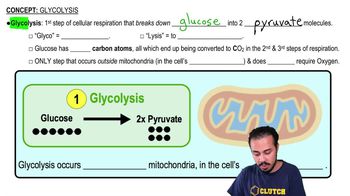
Glycolysis

Glycolysis is the first step in the breakdown of glucose, occurring in the cytoplasm of cells. It converts one molecule of glucose into two molecules of pyruvate, producing a net gain of two ATP and two NADH molecules. This process is anaerobic and sets the stage for further energy extraction in aerobic respiration.
Video consigliato:
05:04
Glycolysis

Citric Acid Cycle

The Citric Acid Cycle, also known as the Krebs cycle, takes place in the mitochondria and is a key component of cellular respiration. It processes acetyl-CoA, derived from pyruvate, to produce energy-rich electron carriers, NADH and FADH2, along with ATP. This cycle is crucial for the complete oxidation of glucose and the release of stored energy.
Video consigliato:
02:45
Acids

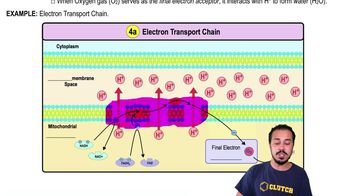
Electron Transport Chain

The Electron Transport Chain (ETC) is the final stage of aerobic respiration, located in the inner mitochondrial membrane. It utilizes the NADH and FADH2 produced in earlier stages to create a proton gradient, driving ATP synthesis through oxidative phosphorylation. Most of the energy from glucose oxidation is stored in the form of ATP generated during this process.
Video consigliato:
07:41
Electron Transport Chain
Pratica correlata