Ch. 9 - Cellular Respiration and Fermentation
Freeman - Biological Science 8th Edition
Freeman8th EditionBiological ScienceISBN: 9780138276263Non è quello che usi tu?Cambia libro di testo
Capitolo 9, Problema 6

If you were to expose cells that are undergoing aerobic respiration to a radioactive oxygen isotope in the form of O2, which of the following molecules would you expect to be radiolabeled?
a. Pyruvate
b. Water
c. NADH
d. CO2

Guida verificata passo dopo passo
1
Understand the process of aerobic respiration: Aerobic respiration involves glycolysis, the citric acid cycle, and oxidative phosphorylation. Oxygen plays a crucial role in the final stage, oxidative phosphorylation, where it acts as the final electron acceptor.
Identify where oxygen is used in aerobic respiration: Oxygen is used in the electron transport chain during oxidative phosphorylation. It combines with electrons and protons to form water (H2O).
Consider the role of radioactive oxygen isotope: If cells are exposed to radioactive oxygen in the form of O2, the radioactive isotope will be incorporated into the molecule that oxygen forms during aerobic respiration.
Determine which molecule is formed from oxygen: In the electron transport chain, oxygen is reduced to form water. Therefore, the radioactive oxygen isotope would be incorporated into water molecules.
Conclude which molecule would be radiolabeled: Based on the understanding that oxygen is converted into water during aerobic respiration, water would be the molecule expected to be radiolabeled.

Risposta video verificata per un problema simile:

Questa soluzione video è stata consigliata dai nostri tutor come utile per risolvere questo problema.
Durata del video:
1m

Concetti chiave

Ecco i concetti essenziali che devi comprendere per rispondere correttamente alla domanda.

Aerobic Respiration

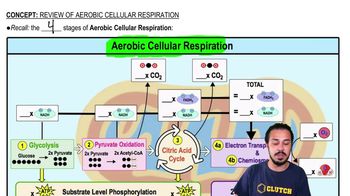
Aerobic respiration is a metabolic process in which cells use oxygen to convert glucose into energy, producing carbon dioxide and water as byproducts. It involves glycolysis, the Krebs cycle, and the electron transport chain, where oxygen acts as the final electron acceptor, forming water.
Video consigliato:
07:51
Review of Aerobic Cellular Respiration

Electron Transport Chain

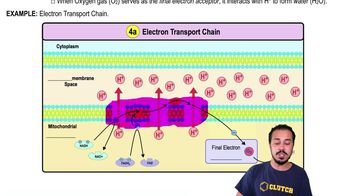
The electron transport chain is the final stage of aerobic respiration, occurring in the inner mitochondrial membrane. Electrons are transferred through a series of proteins, ultimately reducing oxygen to form water. This process generates a proton gradient that drives ATP synthesis, making oxygen crucial for water production.
Video consigliato:
07:41
Electron Transport Chain

Role of Oxygen in Respiration

Oxygen is essential in aerobic respiration as the terminal electron acceptor in the electron transport chain. It combines with electrons and protons to form water, a key byproduct of the process. Thus, when cells are exposed to radioactive oxygen, the water produced will be radiolabeled.
Video consigliato:
03:35
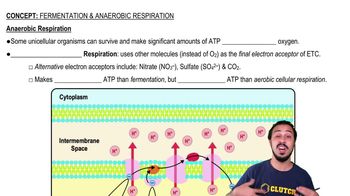
Anaerobic Respiration
Pratica correlata
Domanda del libro di testo

In step 3 of the citric acid cycle, the enzyme isocitrate dehydrogenase is regulated by NADH. Compare and contrast the regulation of this enzyme with the regulation of phosphofructokinase in glycolysis.

1948
views

Domanda del libro di testo

The researchers who observed that magnetite was produced by bacterial cultures from the deep subsurface carried out a follow-up experiment. These biologists treated some of the cultures with a drug that poisons the enzymes involved in electron transport chains. In cultures where the drug was present, no more magnetite was produced. Does this result support or undermine their hypothesis that the bacteria in the cultures perform cellular respiration? Explain your reasoning.

1178
views
Domanda del libro di testo

After glucose is fully oxidized by glycolysis, pyruvate processing, and the citric acid cycle, where is most of its energy stored?

1413
views
Domanda del libro di testo

Compare and contrast substrate-level phosphorylation and oxidative phosphorylation.

2163
views
Domanda del libro di testo

Explain the relationship between electron transport and oxidative phosphorylation. How do uncoupling proteins 'uncouple' this relationship in brown adipose tissue?

1506
views
Domanda del libro di testo

Which of the following correctly describe the fermentation pathway? Select True or False for each statement.

T/FIt includes a reaction that oxidizes NADH to NAD+.

T/FIt synthesizes ATP by substrate-level phosphorylation.

T/FIt includes a reaction that reduces NAD+ to NADH.

T/FIt synthesizes electron acceptors, so that cellular respiration can continue.

3088
views