Ch. 1 - Functions
Briggs - Calculus: Early Transcendentals 3rd Edition
Briggs3rd EditionCalculus: Early TranscendentalsISBN: 9780136847243Non è quello che usi tu?Cambia libro di testo
Capitolo 1, Problema 15.

Evaluate cos⁻¹(cos(5π/4)).

Guida verificata passo dopo passo
1
Recognize that \( \cos^{-1}(x) \) is the inverse function of \( \cos(x) \), which means \( \cos^{-1}(\cos(x)) = x \) for \( x \) in the range of \( \cos^{-1} \).
The range of \( \cos^{-1}(x) \) is \([0, \pi]\).
Determine the angle \( 5\pi/4 \) in radians, which is outside the range \([0, \pi]\).
Find an equivalent angle within the range \([0, \pi]\) that has the same cosine value as \( 5\pi/4 \).
Use the property \( \cos(\theta) = \cos(2\pi - \theta) \) to find the equivalent angle within the range.

Risposta video verificata per un problema simile:

Questa soluzione video è stata consigliata dai nostri tutor come utile per risolvere questo problema.
Durata del video:
4m

Concetti chiave

Ecco i concetti essenziali che devi comprendere per rispondere correttamente alla domanda.

Inverse Trigonometric Functions

Inverse trigonometric functions, such as cos⁻¹(x), are used to find the angle whose cosine is x. These functions have specific ranges; for cos⁻¹(x), the output is restricted to the interval [0, π]. This means that when evaluating cos⁻¹(cos(θ)), the result will depend on the angle θ and its position within the defined range.
Video consigliato:
06:35
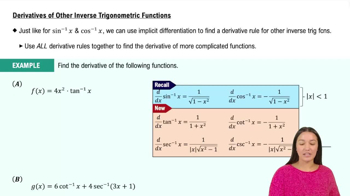
Derivatives of Other Inverse Trigonometric Functions

Cosine Function and Its Periodicity

The cosine function is periodic with a period of 2π, meaning that cos(θ) = cos(θ + 2kπ) for any integer k. This periodicity implies that angles can be expressed in multiple equivalent forms. For example, cos(5π/4) can be simplified by recognizing that it is equivalent to cos(5π/4 - 2π) = cos(-3π/4), which helps in evaluating the inverse function.
Video consigliato:
Percorso guidato
5:53
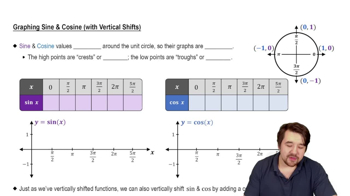
Graph of Sine and Cosine Function

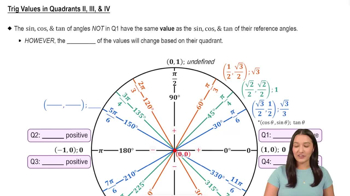
Quadrants and Reference Angles

Understanding the unit circle and the quadrants is essential for evaluating trigonometric functions. The angle 5π/4 is located in the third quadrant, where cosine values are negative. The reference angle for 5π/4 is π/4, which helps in determining the cosine value, as cos(5π/4) = -√2/2. This knowledge is crucial for correctly applying the inverse function.
Video consigliato:
5:30
Trig Values in Quadrants II, III, & IV