Ch. 1 - Functions
Briggs - Calculus: Early Transcendentals 3rd Edition
Briggs3rd EditionCalculus: Early TranscendentalsISBN: 9780136847243Non è quello che usi tu?Cambia libro di testo
Capitolo 1, Problema 15a

Use the graphs of ƒ and g in the figure to determine the following function values. y = f(x) ; y=g(x) <IMAGE>


a. (ƒ o g ) (2)

Guida verificata passo dopo passo
1
Identify the function composition (f o g)(x), which means f(g(x)).
Determine the value of g(2) by locating x = 2 on the graph of g and finding the corresponding y-value.
Use the y-value obtained from g(2) as the input for the function f.
Locate this new input on the graph of f to find the corresponding y-value, which is f(g(2)).
The y-value found in the previous step is the value of (f o g)(2).

Risposta video verificata per un problema simile:

Questa soluzione video è stata consigliata dai nostri tutor come utile per risolvere questo problema.
Durata del video:
2m

Concetti chiave

Ecco i concetti essenziali che devi comprendere per rispondere correttamente alla domanda.

Function Composition

Function composition involves combining two functions, where the output of one function becomes the input of another. In this case, (ƒ o g)(2) means you first evaluate g at 2, and then use that result as the input for the function ƒ. Understanding how to perform this operation is crucial for solving the problem.
Video consigliato:
3:48
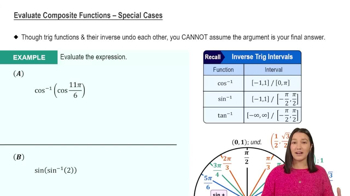
Evaluate Composite Functions - Special Cases

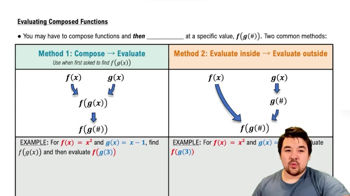
Evaluating Functions

Evaluating functions requires substituting a specific input value into the function's formula or graph. For instance, to find g(2), you would locate the point on the graph of g where x equals 2 and determine the corresponding y-value. This step is essential for finding the correct input for the next function in the composition.
Video consigliato:
Percorso guidato
4:26
Evaluating Composed Functions

Graph Interpretation

Interpreting graphs is vital for understanding the behavior of functions visually. It involves analyzing the plotted points, slopes, and intersections to extract function values. In this question, you will need to read the graphs of ƒ and g accurately to find the necessary values for the composition.
Video consigliato:
Percorso guidato
06:15
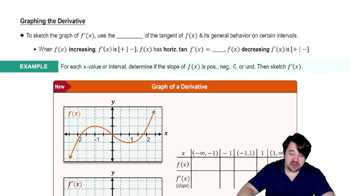
Graphing The Derivative