Ch. 1 - Functions
Briggs - Calculus: Early Transcendentals 3rd Edition
Briggs3rd EditionCalculus: Early TranscendentalsISBN: 9780136847243Non è quello che usi tu?Cambia libro di testo
Capitolo 1, Problema 1.39

Find the inverse f−1(x)f^{-1}\(\left\)(x\(\right\)) of each function (on the given interval, if specified).
f(x)=10−2xf\(\left\)(x\(\right\))=10^{-2x}

Guida verificata passo dopo passo
1
Start by replacing f(x) with y to make the equation easier to work with: y = 10 - 2x.
To find the inverse, swap x and y in the equation. This gives us: x = 10 - 2y.
Solve for y in terms of x. Begin by isolating the term with y: subtract 10 from both sides to get x - 10 = -2y.
Divide both sides by -2 to solve for y: y = (10 - x) / 2.
The inverse function is f^{-1}(x) = (10 - x) / 2. This is the expression for the inverse of the given function.

Risposta video verificata per un problema simile:

Questa soluzione video è stata consigliata dai nostri tutor come utile per risolvere questo problema.
Durata del video:
2m

Concetti chiave

Ecco i concetti essenziali che devi comprendere per rispondere correttamente alla domanda.

Inverse Functions

An inverse function essentially reverses the effect of the original function. If a function f takes an input x and produces an output y, the inverse function f^{-1} takes y as input and returns x. For a function to have an inverse, it must be one-to-one, meaning each output is produced by exactly one input.
Video consigliato:
4:49
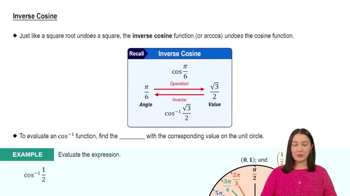
Inverse Cosine

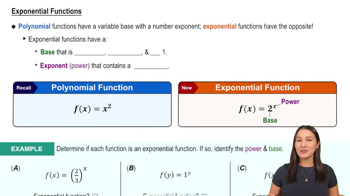
Exponential Functions

Exponential functions are mathematical expressions in the form f(x) = a * b^x, where a is a constant, b is the base (a positive real number), and x is the exponent. In the given function f(x) = 10^{-2x}, the base is 10, and the exponent is -2x, indicating that the function decreases rapidly as x increases, which is characteristic of exponential decay.
Video consigliato:
6:13
Exponential Functions

Finding Inverses Algebraically

To find the inverse of a function algebraically, you typically start by replacing f(x) with y, then solve for x in terms of y. After isolating x, you swap x and y to express the inverse function. This process often involves manipulating equations, such as applying logarithms to exponential functions, to derive the inverse correctly.
Video consigliato:
4:49
Inverse Cosine