
Ch. 1 - Functions
Briggs - Calculus: Early Transcendentals 3rd Edition
Briggs3rd EditionCalculus: Early TranscendentalsISBN: 9780136847243Non è quello che usi tu?Cambia libro di testo
Capitolo 1, Problema 32

Find the inverse function (on the given interval, if specified) and graph both ff and f−1f^{-1} on the same set of axes. Check your work by looking for the required symmetry in the graphs.
f(x)=x2+4f\(\left\)(x\(\right\))=x^2+4, for x≥0x\(\geq{0}\)

Guida verificata passo dopo passo
1
To find the inverse of the function \( f(x) = x^2 + 4 \) for \( x \geq 0 \), start by replacing \( f(x) \) with \( y \), so we have \( y = x^2 + 4 \).
Next, solve for \( x \) in terms of \( y \). Begin by isolating the \( x^2 \) term: \( y - 4 = x^2 \).
Take the square root of both sides to solve for \( x \): \( x = \sqrt{y - 4} \). Since \( x \geq 0 \), we only consider the positive square root.
Thus, the inverse function is \( f^{-1}(y) = \sqrt{y - 4} \). To express it in terms of \( x \), replace \( y \) with \( x \), giving \( f^{-1}(x) = \sqrt{x - 4} \).
To graph both \( f(x) = x^2 + 4 \) and \( f^{-1}(x) = \sqrt{x - 4} \), plot them on the same set of axes. Check for symmetry about the line \( y = x \), which is a characteristic of inverse functions.

Risposta video verificata per un problema simile:

Questa soluzione video è stata consigliata dai nostri tutor come utile per risolvere questo problema.
Durata del video:
12m

Concetti chiave

Ecco i concetti essenziali che devi comprendere per rispondere correttamente alla domanda.

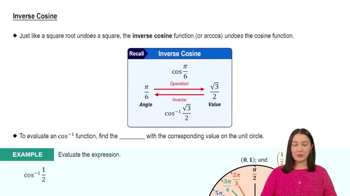
Inverse Functions

An inverse function essentially reverses the effect of the original function. If a function f takes an input x and produces an output y, the inverse function f⁻¹ takes y as input and returns x. For a function to have an inverse, it must be one-to-one (bijective), meaning it passes the horizontal line test, ensuring that each output corresponds to exactly one input.
Video consigliato:
4:49
Inverse Cosine

Graphing Functions

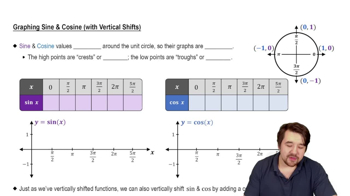
Graphing functions involves plotting points on a coordinate system to visually represent the relationship between the input (x-values) and output (y-values). The graph of a function provides insights into its behavior, such as increasing or decreasing intervals, and can help identify key features like intercepts and asymptotes. When graphing an inverse function, the graph should reflect symmetry about the line y = x.
Video consigliato:
Percorso guidato
5:53
Graph of Sine and Cosine Function

Quadratic Functions

A quadratic function is a polynomial function of degree two, typically expressed in the form f(x) = ax² + bx + c, where a, b, and c are constants and a ≠ 0. The graph of a quadratic function is a parabola, which opens upwards if a > 0 and downwards if a < 0. Understanding the properties of quadratic functions, such as their vertex, axis of symmetry, and direction of opening, is crucial for finding their inverses and analyzing their graphs.
Video consigliato:
Percorso guidato
13:42
Partial Fraction Decomposition: Irreducible Quadratic Factors
Pratica correlata
Domanda del libro di testo

Draining a tank (Torricelli’s law) A cylindrical tank with a cross-sectional area of 1010 m2 is filled to a depth of 2525 m with water. At t=0t=0 s, a drain in the bottom of the tank with an area of 11 m²  is opened, allowing water to flow out of the tank. The depth of water in the tank (in meters) at time t≥0t\(\geq{0}\) is d(t)=(5−0.22t)2d\(\left\)(t\(\right\))=\(\left\)(5-0.22t\(\right\))^2.

b. At what time is the tank empty?

511
views
Domanda del libro di testo

Graphing functions Sketch a graph of each function.


ƒ(x) = { 2x if x ≤ 1 , 3-x if x > 1

381
views
Domanda del libro di testo

Piecewise linear functions Graph the following functions.

f(x)={3x−1, if x≤0−2x−1, if x>0f\(\left\)(x\(\right\))=\(\begin{cases}\)3x-1\(\frac{}{}\),\(\text{ if }\)x\(\le\)0\\ -2x-1,\(\text{ if }\)x>0\(\end{cases}\)

515
views
Domanda del libro di testo

{Use of Tech} Launching a rocket A small rocket is launched vertically upward from the edge of a cliff 8080 ft above the ground at a speed of 9696 ft/s. Its height (in feet) above the ground is given by h(t)=−16t2+96t+80h\(\left\)(t\(\right\))=-16t^2+96t+80, where tt represents time measured in seconds.

a. Assuming the rocket is launched at t=0t=0, what is an appropriate domain for hh?

331
views
Domanda del libro di testo

Draining a tank (Torricelli’s law) A cylindrical tank with a cross-sectional area of 1010 m2 is filled to a depth of 2525 m with water. At t=0t=0 s, a drain in the bottom of the tank with an area of 11 m²  is opened, allowing water to flow out of the tank. The depth of water in the tank (in meters) at time t≥0t\(\geq{0}\) is d(t)=(5−0.22t)2d\(\left\)(t\(\right\))=\(\left\)(5-0.22t\(\right\))^2.

a. Check that d(0)=25d\(\left\)(0\(\right\))=25, as specified.

426
views
Domanda del libro di testo

Draining a tank (Torricelli’s law) A cylindrical tank with a cross-sectional area of 1010 m2 is filled to a depth of 2525 m with water. At t=0t=0 s, a drain in the bottom of the tank with an area of 11 m²  is opened, allowing water to flow out of the tank. The depth of water in the tank (in meters) at time t≥0t\(\geq{0}\) is d(t)=(5−0.22t)2d\(\left\)(t\(\right\))=\(\left\)(5-0.22t\(\right\))^2.

c. What is an appropriate domain for dd?

319
views