Ch. 1 - Functions
Briggs - Calculus: Early Transcendentals 3rd Edition
Briggs3rd EditionCalculus: Early TranscendentalsISBN: 9780136847243Non è quello che usi tu?Cambia libro di testo
Capitolo 1, Problema 31a

{Use of Tech} Launching a rocket A small rocket is launched vertically upward from the edge of a cliff 8080 ft above the ground at a speed of 9696 ft/s. Its height (in feet) above the ground is given by h(t)=−16t2+96t+80h\(\left\)(t\(\right\))=-16t^2+96t+80, where tt represents time measured in seconds.
a. Assuming the rocket is launched at t=0t=0, what is an appropriate domain for hh?

Guida verificata passo dopo passo
1
Identify the function given for the height of the rocket: \( h(t) = -16t^2 + 96t + 80 \). This is a quadratic function representing the height of the rocket over time.
Determine the physical constraints of the problem. Since the rocket is launched from a height of 80 feet, the height \( h(t) \) must be greater than or equal to 0 for the domain to be physically meaningful.
Find the time when the rocket hits the ground by setting \( h(t) = 0 \) and solving the quadratic equation \( -16t^2 + 96t + 80 = 0 \). Use the quadratic formula \( t = \frac{-b \pm \sqrt{b^2 - 4ac}}{2a} \) where \( a = -16 \), \( b = 96 \), and \( c = 80 \).
Calculate the discriminant \( b^2 - 4ac \) to ensure it is non-negative, which confirms that the quadratic equation has real solutions. This will give the times when the rocket is at ground level.
The appropriate domain for \( h(t) \) is from \( t = 0 \) to the larger of the two solutions from the quadratic equation, as this represents the time from launch until the rocket returns to the ground.

Risposta video verificata per un problema simile:

Questa soluzione video è stata consigliata dai nostri tutor come utile per risolvere questo problema.
Durata del video:
9m

Concetti chiave

Ecco i concetti essenziali che devi comprendere per rispondere correttamente alla domanda.

Quadratic Functions

The height of the rocket is modeled by a quadratic function, which is a polynomial of degree two. This function takes the form h(t) = at² + bt + c, where a, b, and c are constants. The graph of a quadratic function is a parabola, which can open upwards or downwards depending on the sign of 'a'. In this case, the negative coefficient of t² indicates that the parabola opens downwards, representing the rocket's ascent and eventual descent.
Video consigliato:
Percorso guidato
13:42
Partial Fraction Decomposition: Irreducible Quadratic Factors

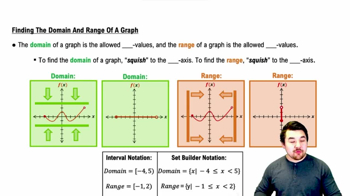
Domain of a Function

The domain of a function refers to the set of all possible input values (in this case, time 't') for which the function is defined. For the rocket's height function h(t), the domain must consider the physical context, such as the time starting from the launch (t=0) and extending to when the rocket hits the ground. This means the domain will be a closed interval starting from t=0 to the time when h(t) equals zero.
Video consigliato:
Percorso guidato
5:10
Finding the Domain and Range of a Graph

Projectile Motion

Projectile motion describes the motion of an object that is launched into the air and is subject to gravitational force. The height of the rocket over time can be analyzed using the equations of motion, which account for initial velocity, acceleration due to gravity, and the height from which it is launched. Understanding projectile motion helps in determining key aspects such as maximum height, time of flight, and the total distance traveled.
Video consigliato:
Percorso guidato
06:51
Derivatives Applied To Acceleration Example 2
Pratica correlata
Domanda del libro di testo

Find the inverse function (on the given interval, if specified) and graph both ff and f−1f^{-1} on the same set of axes. Check your work by looking for the required symmetry in the graphs.

f(x)=x2+4f\(\left\)(x\(\right\))=x^2+4, for x≥0x\(\geq{0}\)

1046
views
Domanda del libro di testo

Draining a tank (Torricelli’s law) A cylindrical tank with a cross-sectional area of 1010 m2 is filled to a depth of 2525 m with water. At t=0t=0 s, a drain in the bottom of the tank with an area of 11 m²  is opened, allowing water to flow out of the tank. The depth of water in the tank (in meters) at time t≥0t\(\geq{0}\) is d(t)=(5−0.22t)2d\(\left\)(t\(\right\))=\(\left\)(5-0.22t\(\right\))^2.

b. At what time is the tank empty?

511
views
Domanda del libro di testo

Graphing functions Sketch a graph of each function.


ƒ(x) = { 2x if x ≤ 1 , 3-x if x > 1

381
views
Domanda del libro di testo

Piecewise linear functions Graph the following functions.

f(x)={3x−1, if x≤0−2x−1, if x>0f\(\left\)(x\(\right\))=\(\begin{cases}\)3x-1\(\frac{}{}\),\(\text{ if }\)x\(\le\)0\\ -2x-1,\(\text{ if }\)x>0\(\end{cases}\)

515
views
Domanda del libro di testo

Draining a tank (Torricelli’s law) A cylindrical tank with a cross-sectional area of 1010 m2 is filled to a depth of 2525 m with water. At t=0t=0 s, a drain in the bottom of the tank with an area of 11 m²  is opened, allowing water to flow out of the tank. The depth of water in the tank (in meters) at time t≥0t\(\geq{0}\) is d(t)=(5−0.22t)2d\(\left\)(t\(\right\))=\(\left\)(5-0.22t\(\right\))^2.

a. Check that d(0)=25d\(\left\)(0\(\right\))=25, as specified.

426
views
Domanda del libro di testo

Graphing equations Graph the following equations. 


c. x² + 2x + y² + 4y + 1 = 0

482
views