Ch. 1 - Functions
Briggs - Calculus: Early Transcendentals 3rd Edition
Briggs3rd EditionCalculus: Early TranscendentalsISBN: 9780136847243Non è quello che usi tu?Cambia libro di testo
Capitolo 1, Problema 9

How do you obtain the graph of y=f(x+2)y=f\(\left\)(x+2\(\right\)) from the graph of y=f(x)y=f\(\left\)(x\(\right\))?

Guida verificata passo dopo passo
1
Understand that the expression y = f(x + 2) represents a horizontal transformation of the function y = f(x).
Recognize that adding a positive number inside the function's argument, such as x + 2, results in a horizontal shift to the left.
To graph y = f(x + 2), take each point (x, y) on the graph of y = f(x) and shift it 2 units to the left, resulting in the new point (x - 2, y).
Ensure that all points on the original graph are shifted consistently to maintain the shape of the graph.
Check the new graph to confirm that it accurately represents the function y = f(x + 2) by verifying a few key points and their transformations.

Risposta video verificata per un problema simile:

Questa soluzione video è stata consigliata dai nostri tutor come utile per risolvere questo problema.
Durata del video:
5m

Concetti chiave

Ecco i concetti essenziali che devi comprendere per rispondere correttamente alla domanda.

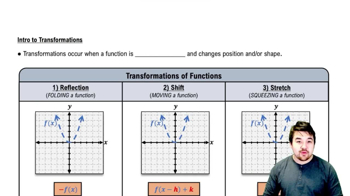
Function Transformation

Function transformation refers to the process of altering the graph of a function through shifts, stretches, or reflections. In this case, the function y = f(x + 2) represents a horizontal shift of the original function y = f(x) to the left by 2 units. Understanding how these transformations affect the graph is crucial for accurately sketching or interpreting the new function.
Video consigliato:
Percorso guidato
5:25
Intro to Transformations

Horizontal Shifts

Horizontal shifts occur when the input variable of a function is adjusted by adding or subtracting a constant. For the function y = f(x + 2), the addition of 2 inside the function's argument indicates a shift to the left. This concept is essential for predicting how the graph will move in relation to the original function.
Video consigliato:
Percorso guidato
5:28
Horizontal Parabolas

Graphing Functions

Graphing functions involves plotting points on a coordinate plane to visually represent the relationship between the input (x) and output (y) values. To graph y = f(x + 2), one must first understand the original graph of y = f(x) and then apply the horizontal shift. This skill is fundamental in calculus for analyzing and interpreting functions.
Video consigliato:
Percorso guidato
5:53
Graph of Sine and Cosine Function