Ch. 1 - Functions
Briggs - Calculus: Early Transcendentals 3rd Edition
Briggs3rd EditionCalculus: Early TranscendentalsISBN: 9780136847243Non è quello che usi tu?Cambia libro di testo
Capitolo 1, Problema 7

What are the three Pythagorean identities for the trigonometric functions?

Guida verificata passo dopo passo
1
The Pythagorean identities are fundamental relationships between the trigonometric functions sine, cosine, and tangent.
The first Pythagorean identity is derived from the Pythagorean theorem and states: \( \sin^2(\theta) + \cos^2(\theta) = 1 \).
The second identity is obtained by dividing the first identity by \( \cos^2(\theta) \), resulting in: \( 1 + \tan^2(\theta) = \sec^2(\theta) \).
The third identity is derived by dividing the first identity by \( \sin^2(\theta) \), leading to: \( 1 + \cot^2(\theta) = \csc^2(\theta) \).
These identities are useful for simplifying expressions and solving trigonometric equations.

Risposta video verificata per un problema simile:

Questa soluzione video è stata consigliata dai nostri tutor come utile per risolvere questo problema.
Durata del video:
4m

Concetti chiave

Ecco i concetti essenziali che devi comprendere per rispondere correttamente alla domanda.

Pythagorean Identities

Pythagorean identities are fundamental relationships in trigonometry that relate the squares of the sine, cosine, and tangent functions. They stem from the Pythagorean theorem, which states that in a right triangle, the square of the hypotenuse equals the sum of the squares of the other two sides. These identities are essential for simplifying trigonometric expressions and solving equations.
Video consigliato:
7:17
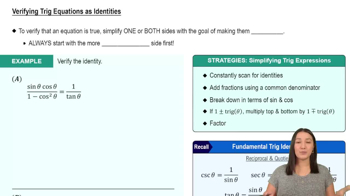
Verifying Trig Equations as Identities

Sine and Cosine Relationship

The first Pythagorean identity states that sin²(θ) + cos²(θ) = 1 for any angle θ. This identity illustrates the relationship between the sine and cosine functions, showing that the sum of their squares is always equal to one. It is crucial for understanding the unit circle and the behavior of trigonometric functions.
Video consigliato:
03:53
Derivatives of Sine & Cosine

Tangent and Secant Relationship

The second Pythagorean identity is 1 + tan²(θ) = sec²(θ), which connects the tangent and secant functions. This identity is derived from the first identity by dividing the sine and cosine functions. It is particularly useful in calculus for differentiating and integrating trigonometric functions, as well as in solving trigonometric equations.
Video consigliato:
Percorso guidato
05:13
Slopes of Tangent Lines