

Ch. 1 - Functions
Briggs - Calculus: Early Transcendentals 3rd Edition
Briggs3rd EditionCalculus: Early TranscendentalsISBN: 9780136847243Non è quello che usi tu?Cambia libro di testo
Capitolo 1, Problema 10.

Solve the equation sin 2Θ = 1, for 0 ≤ Θ < 2π .

Guida verificata passo dopo passo
1
Recognize that \( \sin 2\Theta = 1 \) implies that the angle \( 2\Theta \) is at a point where the sine function equals 1.
Recall that the sine function equals 1 at \( \frac{\pi}{2} + 2k\pi \), where \( k \) is an integer.
Set \( 2\Theta = \frac{\pi}{2} + 2k\pi \) and solve for \( \Theta \) by dividing both sides by 2.
This gives \( \Theta = \frac{\pi}{4} + k\pi \).
Determine the values of \( k \) such that \( 0 \leq \Theta < 2\pi \) to find the solutions within the given interval.

Risposta video verificata per un problema simile:

Questa soluzione video è stata consigliata dai nostri tutor come utile per risolvere questo problema.
Durata del video:
6m

Concetti chiave

Ecco i concetti essenziali che devi comprendere per rispondere correttamente alla domanda.

Trigonometric Functions

Trigonometric functions, such as sine, cosine, and tangent, relate angles to ratios of sides in right triangles. The sine function, specifically, gives the ratio of the length of the opposite side to the hypotenuse. Understanding these functions is crucial for solving equations involving angles, as they describe periodic behaviors and relationships in geometry.
Video consigliato:
Percorso guidato
6:04
Introduction to Trigonometric Functions

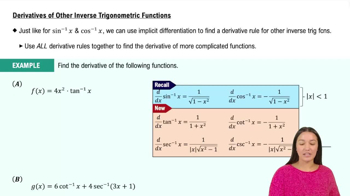
Inverse Trigonometric Functions

Inverse trigonometric functions allow us to determine the angle that corresponds to a given trigonometric ratio. For example, if we know sin(Θ) = 1, we can use the inverse sine function to find the angle Θ. This concept is essential for solving equations where the angle is the unknown variable.
Video consigliato:
06:35
Derivatives of Other Inverse Trigonometric Functions

Periodic Nature of Sine Function

The sine function is periodic, meaning it repeats its values in regular intervals. Specifically, sin(Θ) has a period of 2π, which means that sin(Θ) = sin(Θ + 2πk) for any integer k. This property is important when solving equations like sin(2Θ) = 1, as it allows us to find multiple solutions within a specified interval.
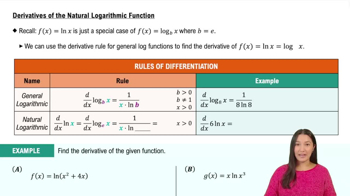
Video consigliato:
05:18
Derivative of the Natural Logarithmic Function