Ch. 1 - Functions
Briggs - Calculus: Early Transcendentals 3rd Edition
Briggs3rd EditionCalculus: Early TranscendentalsISBN: 9780136847243Non è quello che usi tu?Cambia libro di testo
Capitolo 1, Problema 1.74

Inverse sines and cosines Evaluate or simplify the following expressions without using a calculator.


cos⁻¹ (- 1/2 )

Guida verificata passo dopo passo
1
Understand that \( \cos^{-1}(x) \) represents the angle whose cosine is \( x \).
Recall that the range of \( \cos^{-1}(x) \) is \([0, \pi]\).
Identify the angle \( \theta \) in the range \([0, \pi]\) such that \( \cos(\theta) = -\frac{1}{2} \).
Recognize that \( \cos(\pi - \theta) = -\cos(\theta) \), and since \( \cos(\frac{\pi}{3}) = \frac{1}{2} \), then \( \cos(\pi - \frac{\pi}{3}) = -\frac{1}{2} \).
Conclude that \( \theta = \pi - \frac{\pi}{3} \) is the angle in the range \([0, \pi]\) such that \( \cos(\theta) = -\frac{1}{2} \).

Risposta video verificata per un problema simile:

Questa soluzione video è stata consigliata dai nostri tutor come utile per risolvere questo problema.
Durata del video:
3m

Concetti chiave

Ecco i concetti essenziali che devi comprendere per rispondere correttamente alla domanda.

Inverse Trigonometric Functions

Inverse trigonometric functions, such as arcsine and arccosine, are used to find angles when given a ratio of sides in a right triangle. For example, cos⁻¹(x) gives the angle whose cosine is x. These functions are essential for solving problems where the angle is unknown, and they have specific ranges to ensure each output is unique.
Video consigliato:
06:35
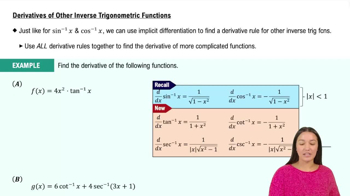
Derivatives of Other Inverse Trigonometric Functions

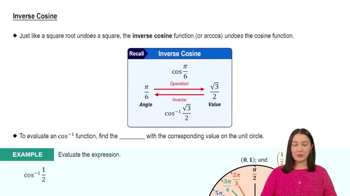
Range of Inverse Cosine

The range of the inverse cosine function, cos⁻¹(x), is restricted to the interval [0, π]. This means that when evaluating cos⁻¹(-1/2), the resulting angle must fall within this range. Understanding this range is crucial for correctly interpreting the output of the inverse cosine function.
Video consigliato:
4:49
Inverse Cosine

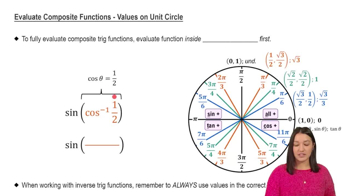
Unit Circle

The unit circle is a fundamental concept in trigonometry that helps visualize the values of trigonometric functions. It is a circle with a radius of one centered at the origin of a coordinate plane. By using the unit circle, one can determine the angles corresponding to specific cosine values, such as -1/2, which corresponds to angles in the second and third quadrants.
Video consigliato:
5:10
Evaluate Composite Functions - Values on Unit Circle