Ch. 1 - Functions
Briggs - Calculus: Early Transcendentals 3rd Edition
Briggs3rd EditionCalculus: Early TranscendentalsISBN: 9780136847243Non è quello che usi tu?Cambia libro di testo
Capitolo 1, Problema 1.44

Working with composite functions
Find possible choices for outer and inner functions ƒ and g such that the given function h equals ƒ o g.
h(x) = (2) / ( x⁶ + x² + 1)²

Guida verificata passo dopo passo
1
Step 1: Identify the structure of the function \( h(x) = \frac{2}{(x^6 + x^2 + 1)^2} \). Notice that it is a composition of functions where the denominator is a function raised to a power.
Step 2: Consider the inner function \( g(x) \). A reasonable choice for \( g(x) \) is the expression inside the parentheses: \( g(x) = x^6 + x^2 + 1 \).
Step 3: Determine the outer function \( f(u) \). Since \( h(x) = \frac{2}{(g(x))^2} \), the outer function \( f(u) \) can be expressed as \( f(u) = \frac{2}{u^2} \), where \( u = g(x) \).
Step 4: Verify the composition. Substitute \( g(x) \) into \( f(u) \) to ensure that \( f(g(x)) = h(x) \). This gives \( f(g(x)) = \frac{2}{(x^6 + x^2 + 1)^2} \), which matches \( h(x) \).
Step 5: Conclude that the functions \( f(u) = \frac{2}{u^2} \) and \( g(x) = x^6 + x^2 + 1 \) are valid choices for the outer and inner functions, respectively, such that \( h(x) = f(g(x)) \).

Risposta video verificata per un problema simile:

Questa soluzione video è stata consigliata dai nostri tutor come utile per risolvere questo problema.
Durata del video:
2m

Concetti chiave

Ecco i concetti essenziali che devi comprendere per rispondere correttamente alla domanda.

Composite Functions

A composite function is formed when one function is applied to the result of another function. It is denoted as (ƒ o g)(x) = ƒ(g(x)), where g is the inner function and ƒ is the outer function. Understanding how to decompose a function into its components is essential for solving problems involving composite functions.
Video consigliato:
3:48
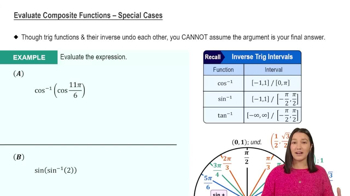
Evaluate Composite Functions - Special Cases

Function Decomposition

Function decomposition involves breaking down a complex function into simpler parts, typically identifying an inner function and an outer function. This process is crucial for analyzing and manipulating functions, especially when working with compositions. In the context of the given function h(x), finding suitable ƒ and g requires recognizing how to express h in terms of simpler functions.
Video consigliato:
Percorso guidato
06:21
Properties of Functions

Identifying Function Forms

Identifying function forms involves recognizing the structure of a function to determine potential inner and outer functions. For the function h(x) = (2) / (x⁶ + x² + 1)², one might consider the denominator as a candidate for the inner function g, while the outer function ƒ could be a transformation applied to the result of g. This skill is vital for effectively working with composite functions.
Video consigliato:
3:56
Slope-Intercept Form