Ch. 1 - Functions
Briggs - Calculus: Early Transcendentals 3rd Edition
Briggs3rd EditionCalculus: Early TranscendentalsISBN: 9780136847243Non è quello che usi tu?Cambia libro di testo
Capitolo 1, Problema 1.35

Find the inverse f−1(x)f^{-1}\(\left\)(x\(\right\)) of each function (on the given interval, if specified).
f(x)=e2x+6f\(\left\)(x\(\right\))=e^{2x+6}

Guida verificata passo dopo passo
1
Start by setting the function equal to y: y = e^{2x + 6}.
To find the inverse, swap x and y: x = e^{2y + 6}.
Solve for y by taking the natural logarithm of both sides: \(\ln\)(x) = 2y + 6.
Isolate y by first subtracting 6 from both sides: \(\ln\)(x) - 6 = 2y.
Finally, divide both sides by 2 to solve for y: y = \(\frac{\ln(x) - 6}{2}\). This is the inverse function, f^{-1}(x).

Risposta video verificata per un problema simile:

Questa soluzione video è stata consigliata dai nostri tutor come utile per risolvere questo problema.
Durata del video:
3m

Concetti chiave

Ecco i concetti essenziali che devi comprendere per rispondere correttamente alla domanda.

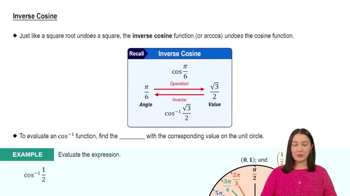
Inverse Functions

An inverse function reverses the effect of the original function. If a function f takes an input x and produces an output y, the inverse function f^{-1} takes y back to x. For a function to have an inverse, it must be one-to-one, meaning each output is produced by exactly one input. This property ensures that the inverse function is well-defined.
Video consigliato:
4:49
Inverse Cosine

Exponential Functions

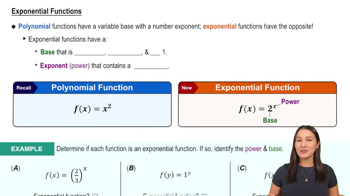
Exponential functions are of the form f(x) = a * e^(bx), where e is the base of natural logarithms, approximately equal to 2.71828. These functions grow rapidly and are characterized by their constant rate of growth proportional to their current value. Understanding their behavior is crucial for finding inverses, especially since the inverse of an exponential function is a logarithmic function.
Video consigliato:
6:13
Exponential Functions

Logarithmic Functions

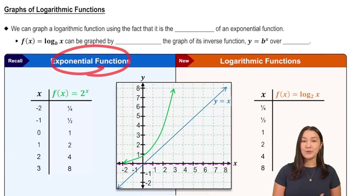
Logarithmic functions are the inverses of exponential functions and are expressed as f^{-1}(x) = log_a(x) when the base is a. They help solve equations where the variable is an exponent. The properties of logarithms, such as the product, quotient, and power rules, are essential for manipulating and simplifying expressions when finding inverses of exponential functions.
Video consigliato:
5:26
Graphs of Logarithmic Functions