
Ch. 1 - Functions
Briggs - Calculus: Early Transcendentals 3rd Edition
Briggs3rd EditionCalculus: Early TranscendentalsISBN: 9780136847243Non è quello che usi tu?Cambia libro di testo
Capitolo 1, Problema 23

Where do inverses exist? Use analytical and/or graphical methods to determine the largest possible sets of points on which the following functions have an inverse.


{Use of Tech} ƒ(x) = 1/(x-5)

Guida verificata passo dopo passo
1
Step 1: Understand the concept of an inverse function. An inverse function exists if a function is one-to-one (bijective), meaning it passes the horizontal line test. This implies that for every y-value, there is exactly one x-value.
Step 2: Analyze the function \( f(x) = \frac{1}{x-5} \). Notice that this is a rational function with a vertical asymptote at \( x = 5 \), where the function is undefined.
Step 3: Consider the domain of \( f(x) \). The function is defined for all real numbers except \( x = 5 \). Therefore, the domain is \( (-\infty, 5) \cup (5, \infty) \).
Step 4: Check if the function is one-to-one on its domain. Since \( f(x) = \frac{1}{x-5} \) is a strictly decreasing function on each interval \( (-\infty, 5) \) and \( (5, \infty) \), it passes the horizontal line test on these intervals.
Step 5: Conclude that the function \( f(x) = \frac{1}{x-5} \) has an inverse on each of the intervals \( (-\infty, 5) \) and \( (5, \infty) \), as it is one-to-one on these intervals.

Risposta video verificata per un problema simile:

Questa soluzione video è stata consigliata dai nostri tutor come utile per risolvere questo problema.
Durata del video:
3m

Concetti chiave

Ecco i concetti essenziali che devi comprendere per rispondere correttamente alla domanda.

Inverse Functions

An inverse function essentially reverses the effect of the original function. For a function f(x), its inverse f⁻¹(x) satisfies the condition f(f⁻¹(x)) = x for all x in the domain of f⁻¹. A function has an inverse if it is one-to-one, meaning it passes the horizontal line test, where no horizontal line intersects the graph of the function more than once.
Video consigliato:
4:49
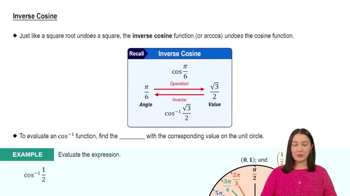
Inverse Cosine

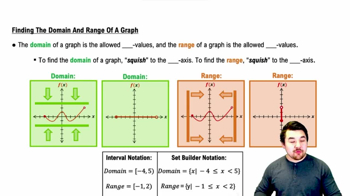
Domain and Range

The domain of a function is the set of all possible input values (x-values) for which the function is defined, while the range is the set of all possible output values (y-values). Understanding the domain and range is crucial for determining where a function is invertible, as the range of the original function becomes the domain of its inverse.
Video consigliato:
Percorso guidato
5:10
Finding the Domain and Range of a Graph

Horizontal Line Test

The horizontal line test is a graphical method used to determine if a function is one-to-one. If any horizontal line intersects the graph of the function more than once, the function fails the test and does not have an inverse. This test is particularly useful for visualizing the behavior of functions and identifying intervals where they may be invertible.
Video consigliato:
Percorso guidato
05:13
Slopes of Tangent Lines