Explain why the magnitude of the remainder in an alternating series (with terms that are nonincreasing in magnitude) is less than or equal to the magnitude of the first neglected term.
Ch. 10 - Sequences and Infinite Series
Briggs3rd EditionCalculus: Early TranscendentalsISBN: 9780136847243Non è quello che usi tu?Cambia libro di testo
Capitolo 10, Problema 10.2.41
13–52. Limits of sequences
Find the limit of the following sequences or determine that the sequence diverges.
{ⁿ√(e³ⁿ⁺⁴)}
Guida verificata passo dopo passo1
Identify the general term of the sequence: \(a_n = \sqrt[n]{e^{3n + 4}}\).
Rewrite the nth root expression using exponent properties: \(a_n = \left(e^{3n + 4}\right)^{\frac{1}{n}}\).
Simplify the exponent by distributing the \(\frac{1}{n}\): \(a_n = e^{\frac{3n + 4}{n}}\).
Separate the fraction in the exponent: \(a_n = e^{3 + \frac{4}{n}}\).
Analyze the limit as \(n \to \infty\): since \(\frac{4}{n} \to 0\), the limit of \(a_n\) is \(e^3\).

Risposta video verificata per un problema simile:
Questa soluzione video è stata consigliata dai nostri tutor come utile per risolvere questo problema.
Durata del video:
2mConcetti chiave
Ecco i concetti essenziali che devi comprendere per rispondere correttamente alla domanda.
Limits of Sequences
The limit of a sequence is the value that the terms of the sequence approach as the index goes to infinity. If the terms get arbitrarily close to a specific number, the sequence converges to that limit; otherwise, it diverges. Understanding limits helps determine the long-term behavior of sequences.
Video consigliato:
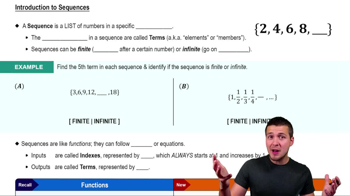
Introduction to Sequences
Properties of Exponential and Root Functions
Exponential functions grow or decay at rates depending on their exponents, while root functions (like nth roots) can be rewritten using fractional exponents. Simplifying expressions involving roots and exponentials often involves rewriting nth roots as powers with exponent 1/n to analyze limits effectively.
Video consigliato:
Percorso guidato
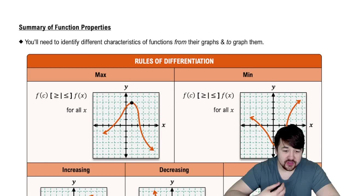
Properties of Functions
Limit Laws and Simplification Techniques
Limit laws allow the separation and simplification of complex expressions into manageable parts. For sequences involving powers and roots, rewriting terms using exponent rules and applying limits to each component helps find the overall limit. Recognizing dominant terms is key to evaluating limits correctly.
Video consigliato:
One-Sided Limits
Pratica correlata
Domanda del libro di testo
86
views
Domanda del libro di testo
21–42. Geometric series Evaluate each geometric series or state that it diverges.
41.∑ (k = 1 to ∞) 4 / 12ᵏ
42
views
Domanda del libro di testo
11–86. Applying convergence tests Determine whether the following series converge. Justify your answers.
∑ (from k = 1 to ∞) k⁴ / (eᵏ⁵)
66
views
Domanda del libro di testo
Growth rates of sequences
Use Theorem 10.6 to find the limit of the following sequences or state that they diverge.
{n¹⁰ / ln20n}
70
views
Domanda del libro di testo
9–36. Comparison tests Use the Comparison Test or the Limit Comparison Test to determine whether the following series converge.
∑ (k = 1 to ∞) sin(1 / k) / k²
79
views
Domanda del libro di testo
Simplify k! / (k + 2)! for any integer k ≥ 0.
60
views