Explain why the magnitude of the remainder in an alternating series (with terms that are nonincreasing in magnitude) is less than or equal to the magnitude of the first neglected term.
Ch. 10 - Sequences and Infinite Series
Briggs3rd EditionCalculus: Early TranscendentalsISBN: 9780136847243Non è quello che usi tu?Cambia libro di testo
Capitolo 10, Problema 10.7.5
Simplify k! / (k + 2)! for any integer k ≥ 0.
Guida verificata passo dopo passo1
Recall the definition of factorial: for any integer n ≥ 0, n! = n × (n - 1) × (n - 2) × ... × 1, and 0! = 1 by convention.
Express the denominator (k + 2)! in terms of k!: write (k + 2)! as (k + 2) × (k + 1) × k!.
Rewrite the original expression \( \frac{k!}{(k + 2)!} \) by substituting the expanded form of (k + 2)!: \( \frac{k!}{(k + 2) \times (k + 1) \times k!} \).
Cancel the common factor k! in numerator and denominator, simplifying the expression to \( \frac{1}{(k + 2) \times (k + 1)} \).
Conclude that the simplified form of \( \frac{k!}{(k + 2)!} \) is \( \frac{1}{(k + 2)(k + 1)} \) for any integer k ≥ 0.

Risposta video verificata per un problema simile:
Questa soluzione video è stata consigliata dai nostri tutor come utile per risolvere questo problema.
Durata del video:
1mConcetti chiave
Ecco i concetti essenziali che devi comprendere per rispondere correttamente alla domanda.
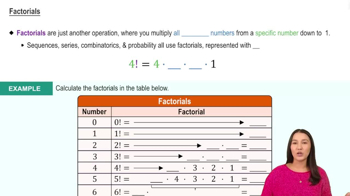
Factorial Definition
The factorial of a non-negative integer n, denoted n!, is the product of all positive integers from 1 up to n. By definition, 0! = 1. Understanding factorials is essential for simplifying expressions involving factorial terms.
Video consigliato:
Factorials
Factorial Expansion and Cancellation
To simplify ratios of factorials like k! / (k + 2)!, expand the larger factorial to reveal common factors. For example, (k + 2)! = (k + 2)(k + 1)k!, allowing cancellation of k! in numerator and denominator.
Video consigliato:
Factorials
Simplification of Rational Expressions
After canceling common factorial terms, simplify the remaining expression by performing arithmetic operations. This often reduces complex factorial ratios to simpler algebraic fractions or products.
Video consigliato:
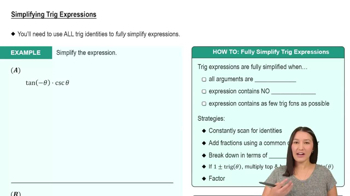
Simplifying Trig Expressions
Pratica correlata
Domanda del libro di testo
86
views
Domanda del libro di testo
21–42. Geometric series Evaluate each geometric series or state that it diverges.
41.∑ (k = 1 to ∞) 4 / 12ᵏ
42
views
Domanda del libro di testo
13–52. Limits of sequences
Find the limit of the following sequences or determine that the sequence diverges.
{ⁿ√(e³ⁿ⁺⁴)}
34
views
Domanda del libro di testo
9–36. Comparison tests Use the Comparison Test or the Limit Comparison Test to determine whether the following series converge.
∑ (k = 1 to ∞) sin(1 / k) / k²
79
views
Domanda del libro di testo
32–49. Choose your test Use the test of your choice to determine whether the following series converge absolutely, converge conditionally, or diverge.
∑ (from k = 1 to ∞) (−1)ᵏ / k⁰.⁹⁹
33
views
Domanda del libro di testo
39–44. {Use of Tech} Estimating infinite series Estimate the value of the following convergent series with an absolute error less than 10⁻³.
∑ (k = 1 to ∞) (−1)ᵏ / kᵏ
60
views