Explain why the magnitude of the remainder in an alternating series (with terms that are nonincreasing in magnitude) is less than or equal to the magnitude of the first neglected term.
Ch. 10 - Sequences and Infinite Series
Briggs3rd EditionCalculus: Early TranscendentalsISBN: 9780136847243Non è quello che usi tu?Cambia libro di testo
Capitolo 10, Problema 10.5.23
9–36. Comparison tests Use the Comparison Test or the Limit Comparison Test to determine whether the following series converge.
∑ (k = 1 to ∞) sin(1 / k) / k²
Guida verificata passo dopo passo1
First, identify the general term of the series: \(a_k = \frac{\sin(1/k)}{k^2}\).
Recall that for large \(k\), \(\sin(1/k)\) behaves approximately like \(1/k\) because \(\sin x \approx x\) when \(x\) is close to 0.
Use this approximation to compare \(a_k\) with a simpler series term: \(b_k = \frac{1/k}{k^2} = \frac{1}{k^3}\).
Since \(\sum_{k=1}^\infty \frac{1}{k^3}\) is a p-series with \(p=3 > 1\), it converges.
Apply the Limit Comparison Test by computing \(\lim_{k \to \infty} \frac{a_k}{b_k} = \lim_{k \to \infty} \frac{\sin(1/k)/k^2}{1/k^3} = \lim_{k \to \infty} \frac{\sin(1/k)}{1/k}\). Since this limit is finite and nonzero, both series share the same convergence behavior, so the original series converges.

Risposta video verificata per un problema simile:
Questa soluzione video è stata consigliata dai nostri tutor come utile per risolvere questo problema.
Durata del video:
3mConcetti chiave
Ecco i concetti essenziali che devi comprendere per rispondere correttamente alla domanda.
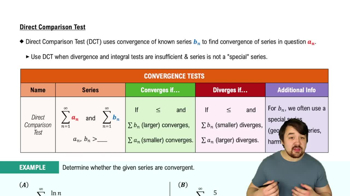
Comparison Test
The Comparison Test determines the convergence of a series by comparing it to a second series with known behavior. If the terms of the given series are smaller than those of a convergent series with positive terms, then the given series also converges. Conversely, if the terms are larger than those of a divergent series, the given series diverges.
Video consigliato:
Percorso guidato
Direct Comparison Test
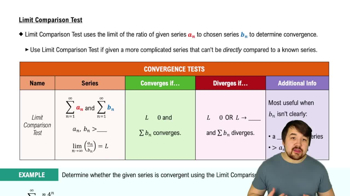
Limit Comparison Test
The Limit Comparison Test compares two series by taking the limit of the ratio of their terms. If this limit is a positive finite number, both series either converge or diverge together. This test is useful when direct comparison is difficult but the terms behave similarly for large indices.
Video consigliato:
Percorso guidato
Limit Comparison Test
Behavior of sin(1/k) for large k
For large values of k, sin(1/k) can be approximated by its argument 1/k because sin(x) ≈ x when x is close to zero. This approximation helps simplify the given series terms to roughly 1/(k³), aiding in the application of comparison tests with p-series.
Video consigliato:
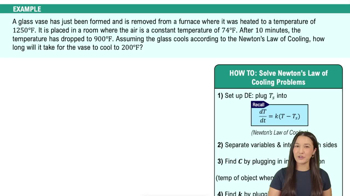
Newton's Law of Cooling Example 5
Pratica correlata
Domanda del libro di testo
86
views
Domanda del libro di testo
23–38. Divergence, Integral, and p-series Tests Use the Divergence Test, the Integral Test, or the p-series test to determine whether the following series converge.
∑ (k = 1 to ∞) k / eᵏ
59
views
Domanda del libro di testo
13–52. Limits of sequences
Find the limit of the following sequences or determine that the sequence diverges.
{ⁿ√(e³ⁿ⁺⁴)}
34
views
Domanda del libro di testo
32–49. Choose your test Use the test of your choice to determine whether the following series converge absolutely, converge conditionally, or diverge.
∑ (from k = 1 to ∞) (−1)ᵏ / k⁰.⁹⁹
33
views
Domanda del libro di testo
Simplify k! / (k + 2)! for any integer k ≥ 0.
60
views
Domanda del libro di testo
39–44. {Use of Tech} Estimating infinite series Estimate the value of the following convergent series with an absolute error less than 10⁻³.
∑ (k = 1 to ∞) (−1)ᵏ / kᵏ
60
views