Ch. 10 - Sequences and Infinite Series
Briggs - Calculus: Early Transcendentals 3rd Edition
Briggs3rd EditionCalculus: Early TranscendentalsISBN: 9780136847243Non è quello che usi tu?Cambia libro di testo
Capitolo 10, Problema 10.2.37

13–52. Limits of sequences
Find the limit of the following sequences or determine that the sequence diverges.


{√(n² + 1) − n} 

Guida verificata passo dopo passo
1
Start by examining the sequence given: \(a_n = \sqrt{n^2 + 1} - n\).
To find the limit as \(n\) approaches infinity, consider rationalizing the expression by multiplying and dividing by the conjugate: \(\sqrt{n^2 + 1} + n\).
Rewrite the sequence as \(a_n = \frac{(\sqrt{n^2 + 1} - n)(\sqrt{n^2 + 1} + n)}{\sqrt{n^2 + 1} + n} = \frac{n^2 + 1 - n^2}{\sqrt{n^2 + 1} + n} = \frac{1}{\sqrt{n^2 + 1} + n}\).
Analyze the denominator \(\sqrt{n^2 + 1} + n\) as \(n\) becomes very large. Since \(\sqrt{n^2 + 1}\) behaves like \(n\) for large \(n\), the denominator grows approximately like \$2n$.
Therefore, the sequence behaves like \(\frac{1}{2n}\) for large \(n\), and you can conclude the limit by considering the behavior of this simplified form as \(n\) approaches infinity.

Risposta video verificata per un problema simile:

Questa soluzione video è stata consigliata dai nostri tutor come utile per risolvere questo problema.
Durata del video:
4m

Concetti chiave

Ecco i concetti essenziali che devi comprendere per rispondere correttamente alla domanda.

Limit of a Sequence

The limit of a sequence is the value that the terms of the sequence approach as the index n becomes very large. If the terms get arbitrarily close to a specific number, the sequence converges to that limit; otherwise, it diverges.
Video consigliato:
8:22
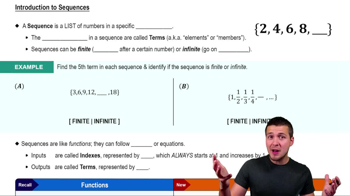
Introduction to Sequences

Algebraic Manipulation for Limits

When evaluating limits involving expressions like √(n² + 1) − n, algebraic techniques such as rationalizing the expression by multiplying numerator and denominator by the conjugate help simplify the expression and reveal the limit more clearly.
Video consigliato:
05:21
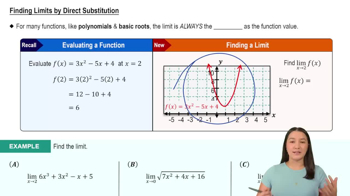
Finding Limits by Direct Substitution

Behavior of Functions as n Approaches Infinity

Understanding how functions behave as n grows large, especially dominant terms like n² inside a square root, is crucial. Recognizing that √(n² + 1) behaves like n for large n helps in approximating and finding the limit.
Video consigliato:
5:46
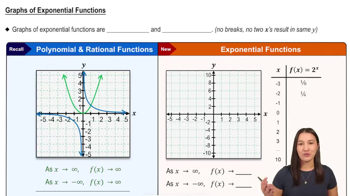
Graphs of Exponential Functions