Ch. 10 - Sequences and Infinite Series
Briggs - Calculus: Early Transcendentals 3rd Edition
Briggs3rd EditionCalculus: Early TranscendentalsISBN: 9780136847243Non è quello che usi tu?Cambia libro di testo
Capitolo 10, Problema 10.2.23

13–52. Limits of sequences
Find the limit of the following sequences or determine that the sequence diverges.


{(√(4n⁴ + 3n))⁄(8n² + 1)}  

Guida verificata passo dopo passo
1
Identify the given sequence: \(a_n = \frac{\sqrt{4n^4 + 3n}}{8n^2 + 1}\).
To find the limit as \(n \to \infty\), first analyze the dominant terms in the numerator and denominator. The highest power of \(n\) inside the square root is \(n^4\), and in the denominator it is \(n^2\).
Rewrite the numerator by factoring out \(n^4\) inside the square root: \(\sqrt{4n^4 + 3n} = \sqrt{n^4(4 + \frac{3}{n^3})} = n^2 \sqrt{4 + \frac{3}{n^3}}\).
Rewrite the denominator as \(8n^2 + 1 = n^2(8 + \frac{1}{n^2})\).
Express the sequence as \(a_n = \frac{n^2 \sqrt{4 + \frac{3}{n^3}}}{n^2 (8 + \frac{1}{n^2})} = \frac{\sqrt{4 + \frac{3}{n^3}}}{8 + \frac{1}{n^2}}\). Then, take the limit as \(n \to \infty\) by evaluating the limits of the numerator and denominator separately.

Risposta video verificata per un problema simile:

Questa soluzione video è stata consigliata dai nostri tutor come utile per risolvere questo problema.
Durata del video:
3m

Concetti chiave

Ecco i concetti essenziali che devi comprendere per rispondere correttamente alla domanda.

Limits of Sequences

The limit of a sequence describes the value that the terms of the sequence approach as the index n goes to infinity. If the terms get arbitrarily close to a finite number, the sequence converges; otherwise, it diverges. Understanding this helps determine the behavior of sequences for large n.
Video consigliato:
8:22
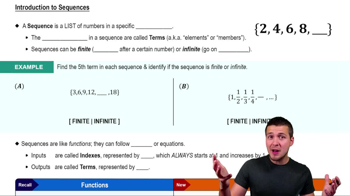
Introduction to Sequences

Asymptotic Behavior and Dominant Terms

When evaluating limits of sequences involving polynomials or roots, focus on the highest-degree terms in numerator and denominator. These dominant terms dictate the growth rate and simplify the expression, making it easier to find the limit as n approaches infinity.
Video consigliato:
Percorso guidato
5:50
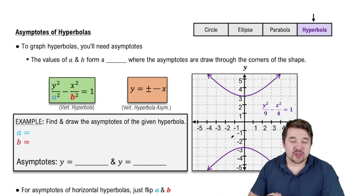
Asymptotes of Hyperbolas

Simplification Using Algebraic Manipulation

Techniques like factoring, dividing numerator and denominator by the highest power of n, or rationalizing expressions help simplify complex sequences. This process reveals the underlying behavior of the sequence and aids in accurately computing the limit.
Video consigliato:
05:25
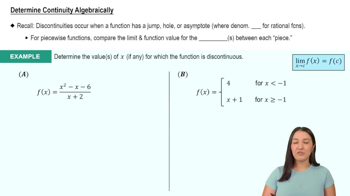
Determine Continuity Algebraically