Ch. 10 - Sequences and Infinite Series
Briggs - Calculus: Early Transcendentals 3rd Edition
Briggs3rd EditionCalculus: Early TranscendentalsISBN: 9780136847243Non è quello che usi tu?Cambia libro di testo
Capitolo 10, Problema 10.1.5

Find two different explicit formulas for the sequence {1, -2, 3, -4, -5 .....}

Guida verificata passo dopo passo
1
First, observe the pattern of the sequence: the terms alternate in sign and increase in absolute value by 1 each time. The sequence is {1, -2, 3, -4, 5, -6, ...}. Note that the sign alternates and the magnitude is simply the term's position in the sequence.
To capture the alternating sign, use the factor \((-1)^{n+1}\) or \((-1)^{n}\), since these expressions alternate between +1 and -1 as \(n\) increases. For example, \((-1)^{n+1}\) is positive when \(n\) is odd and negative when \(n\) is even.
The magnitude of each term is just \(n\), the position in the sequence. So one explicit formula can be written as \(a_n = (-1)^{n+1} \times n\).
For a second explicit formula, consider using the floor or ceiling functions or an expression involving powers of \(-1\) in a different way. For example, you can write \(a_n = (-1)^{n+1} \cdot n\) or \(a_n = (-1)^{n+1} \cdot n\) (which is the same), so try expressing the sign as \(1 - 2(n \bmod 2)\) or \((-1)^n\) with a shift in \(n\) to get the sign pattern.
Another way is to write the sign as \((-1)^{n+1}\) and the magnitude as \(n\), or alternatively, use \(a_n = (-1)^{n+1} \cdot n\) and \(a_n = (-1)^{n+1} \cdot n\) but with \(n\) replaced by \(n\) or \(n\) shifted by 1, depending on the indexing. The key is to express the alternating sign and the magnitude explicitly.

Risposta video verificata per un problema simile:

Questa soluzione video è stata consigliata dai nostri tutor come utile per risolvere questo problema.
Durata del video:
2m

Concetti chiave

Ecco i concetti essenziali che devi comprendere per rispondere correttamente alla domanda.

Sequences and Explicit Formulas

A sequence is an ordered list of numbers following a specific pattern. An explicit formula defines the nth term directly as a function of n, allowing calculation of any term without knowing previous terms.
Video consigliato:
5:17
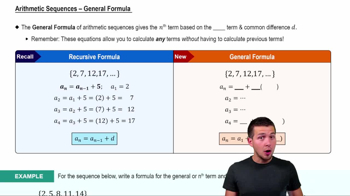
Arithmetic Sequences - General Formula

Alternating Sign Patterns

Alternating sign sequences switch between positive and negative values, often modeled using powers of -1, such as (-1)^n or (-1)^{n+1}, to represent the sign change at each term.
Video consigliato:
Percorso guidato
10:54
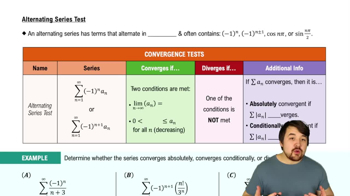
Alternating Series Test

Piecewise and General Term Construction

Constructing explicit formulas may involve combining absolute values, powers, or piecewise definitions to capture complex patterns, such as alternating signs combined with increasing magnitudes.
Video consigliato:
Percorso guidato
05:36
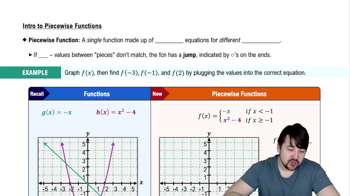
Piecewise Functions