Explain why the magnitude of the remainder in an alternating series (with terms that are nonincreasing in magnitude) is less than or equal to the magnitude of the first neglected term.
Ch. 10 - Sequences and Infinite Series
Briggs3rd EditionCalculus: Early TranscendentalsISBN: 9780136847243Non è quello che usi tu?Cambia libro di testo
Capitolo 10, Problema 10.7.45
32–49. Choose your test Use the test of your choice to determine whether the following series converge absolutely, converge conditionally, or diverge.
∑ (from k = 1 to ∞) (−1)ᵏ / k⁰.⁹⁹
Guida verificata passo dopo passo1
Identify the given series: \( \sum_{k=1}^{\infty} \frac{(-1)^k}{k^{0.99}} \). This is an alternating series because of the factor \( (-1)^k \).
Check if the series converges absolutely by considering the absolute value of the terms: \( \sum_{k=1}^{\infty} \left| \frac{(-1)^k}{k^{0.99}} \right| = \sum_{k=1}^{\infty} \frac{1}{k^{0.99}} \).
Determine whether the series \( \sum_{k=1}^{\infty} \frac{1}{k^{0.99}} \) converges. Recall that the p-series \( \sum \frac{1}{k^p} \) converges if and only if \( p > 1 \). Since \( 0.99 < 1 \), this series diverges, so the original series does not converge absolutely.
Apply the Alternating Series Test (Leibniz Test) to the original series. Check two conditions: (1) the terms \( b_k = \frac{1}{k^{0.99}} \) decrease monotonically, and (2) \( \lim_{k \to \infty} b_k = 0 \). Both conditions hold here.
Conclude that since the series converges by the Alternating Series Test but does not converge absolutely, it converges conditionally.

Risposta video verificata per un problema simile:
Questa soluzione video è stata consigliata dai nostri tutor come utile per risolvere questo problema.
Durata del video:
6mConcetti chiave
Ecco i concetti essenziali che devi comprendere per rispondere correttamente alla domanda.
Absolute Convergence
A series ∑a_k converges absolutely if the series of absolute values ∑|a_k| converges. Absolute convergence guarantees convergence regardless of the signs of the terms. Testing absolute convergence often involves comparison or p-series tests.
Video consigliato:
Percorso guidato
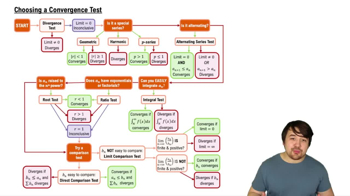
Choosing a Convergence Test
Conditional Convergence
A series converges conditionally if it converges but does not converge absolutely. This typically occurs in alternating series where the terms decrease in magnitude to zero, but the absolute series diverges. The Alternating Series Test is commonly used to verify this.
Video consigliato:
Percorso guidato
Choosing a Convergence Test
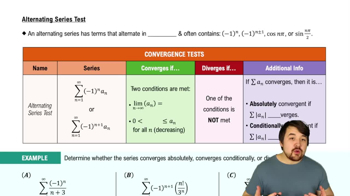
Alternating Series Test
This test determines convergence of series whose terms alternate in sign. If the absolute value of terms decreases monotonically to zero, the series converges. It does not guarantee absolute convergence, only conditional convergence.
Video consigliato:
Percorso guidato
Alternating Series Test
Pratica correlata
Domanda del libro di testo
86
views
Domanda del libro di testo
23–38. Divergence, Integral, and p-series Tests Use the Divergence Test, the Integral Test, or the p-series test to determine whether the following series converge.
∑ (k = 1 to ∞) k / eᵏ
59
views
Domanda del libro di testo
9–36. Comparison tests Use the Comparison Test or the Limit Comparison Test to determine whether the following series converge.
∑ (k = 1 to ∞) sin(1 / k) / k²
79
views
Domanda del libro di testo
Simplify k! / (k + 2)! for any integer k ≥ 0.
60
views
Domanda del libro di testo
39–44. {Use of Tech} Estimating infinite series Estimate the value of the following convergent series with an absolute error less than 10⁻³.
∑ (k = 1 to ∞) (−1)ᵏ / kᵏ
60
views
Domanda del libro di testo
45–63. Absolute and conditional convergence Determine whether the following series converge absolutely, converge conditionally, or diverge.
∑ (k = 1 to ∞) (−1)ᵏ⁺¹ / (2√k − 1)
94
views