Ch. 10 - Sequences and Infinite Series
Briggs - Calculus: Early Transcendentals 3rd Edition
Briggs3rd EditionCalculus: Early TranscendentalsISBN: 9780136847243Non è quello che usi tu?Cambia libro di testo
Capitolo 10, Problema 10.4.41d

41–44. {Use of Tech} Remainders and estimates Consider the following convergent series.


d. Find an interval in which the value of the series must lie if you approximate it using ten terms of the series.


41. ∑ (k = 1 to ∞) 1 / k⁶

Guida verificata passo dopo passo
1
Recognize that the series given is \( \sum_{k=1}^{\infty} \frac{1}{k^6} \), which is a convergent p-series with \( p = 6 > 1 \). This means the series converges absolutely and the remainder after \( n \) terms can be estimated using the integral test remainder bounds.
To approximate the sum using the first 10 terms, calculate the partial sum \( S_{10} = \sum_{k=1}^{10} \frac{1}{k^6} \). This is the sum of the first 10 terms of the series.
Use the integral test remainder estimate to find bounds for the remainder \( R_{10} = S - S_{10} \), where \( S \) is the total sum of the series. The remainder satisfies the inequalities: \[ \int_{11}^{\infty} \frac{1}{x^6} \, dx \leq R_{10} \leq \int_{10}^{\infty} \frac{1}{x^6} \, dx \] These integrals provide lower and upper bounds for the error when approximating the infinite sum by the first 10 terms.
Evaluate the improper integrals: \[ \int_{a}^{\infty} \frac{1}{x^6} \, dx = \left[ -\frac{1}{5x^5} \right]_{a}^{\infty} = \frac{1}{5a^5} \] Use this formula to compute the bounds for \( R_{10} \) by substituting \( a = 10 \) and \( a = 11 \).
Finally, add these remainder bounds to the partial sum \( S_{10} \) to get the interval in which the total sum \( S \) lies: \[ S_{10} + \int_{11}^{\infty} \frac{1}{x^6} \, dx \leq S \leq S_{10} + \int_{10}^{\infty} \frac{1}{x^6} \, dx \] This interval gives a guaranteed range for the value of the series when approximated by the first 10 terms.

Risposta video verificata per un problema simile:

Questa soluzione video è stata consigliata dai nostri tutor come utile per risolvere questo problema.
Durata del video:
6m

Concetti chiave

Ecco i concetti essenziali che devi comprendere per rispondere correttamente alla domanda.

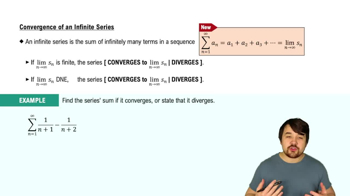
Convergent Infinite Series

A convergent infinite series is a sum of infinitely many terms that approaches a finite limit. For the series ∑ 1/k⁶, since the exponent 6 > 1, the p-series test confirms convergence. Understanding convergence ensures the series sum exists and can be approximated by partial sums.
Video consigliato:
Percorso guidato
06:52
Convergence of an Infinite Series

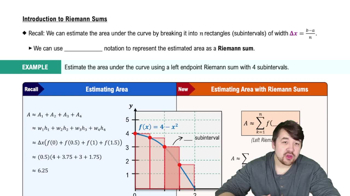
Partial Sums and Approximation

Partial sums are the sums of the first n terms of a series and serve as approximations to the total infinite sum. Using ten terms means calculating the sum from k=1 to 10, which approximates the series' value. The accuracy depends on how quickly the remaining terms decrease.
Video consigliato:
Percorso guidato
06:11
Introduction to Riemann Sums

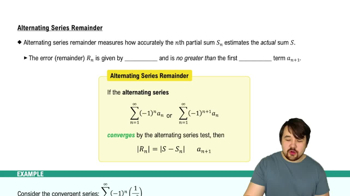
Remainder (Error) Estimates for Series

The remainder after n terms is the difference between the infinite sum and the nth partial sum. For decreasing positive term series like ∑ 1/k⁶, the remainder can be bounded using the integral test, providing an interval where the true sum lies. This helps estimate the error in approximations.
Video consigliato:
Percorso guidato
06:32
Alternating Series Remainder