
Ch. 10 - Sequences and Infinite Series
Briggs - Calculus: Early Transcendentals 3rd Edition
Briggs3rd EditionCalculus: Early TranscendentalsISBN: 9780136847243Non è quello che usi tu?Cambia libro di testo
Capitolo 10, Problema 10.4.47d

Explain why or why not Determine whether the following statements are true and give an explanation or counterexample.


d. Every partial sum Sₙ of the series ∑ (k = 1 to ∞) 1 / k² underestimates the exact value of ∑ (k = 1 to ∞) 1 / k².

Guida verificata passo dopo passo
1
Recall that the series \( \sum_{k=1}^\infty \frac{1}{k^2} \) is a convergent series with positive terms, known as the p-series with \( p = 2 > 1 \).
The partial sum \( S_n = \sum_{k=1}^n \frac{1}{k^2} \) represents the sum of the first \( n \) terms of the series.
Since all terms \( \frac{1}{k^2} > 0 \), the sequence of partial sums \( S_n \) is strictly increasing, meaning \( S_1 < S_2 < S_3 < \cdots \).
Because the series converges to a finite limit \( S = \sum_{k=1}^\infty \frac{1}{k^2} \), and the partial sums increase towards this limit, each partial sum \( S_n \) must be less than or equal to \( S \).
Therefore, every partial sum \( S_n \) underestimates the exact value of the infinite series \( \sum_{k=1}^\infty \frac{1}{k^2} \), making the statement true.

Risposta video verificata per un problema simile:

Questa soluzione video è stata consigliata dai nostri tutor come utile per risolvere questo problema.
Durata del video:
1m

Concetti chiave

Ecco i concetti essenziali che devi comprendere per rispondere correttamente alla domanda.

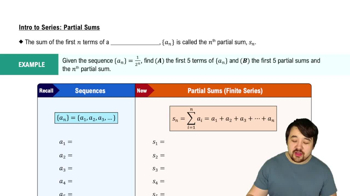
Partial Sums of Infinite Series

A partial sum Sₙ is the sum of the first n terms of an infinite series. It approximates the total sum, and understanding how these sums behave helps determine if they overestimate or underestimate the series' exact value.
Video consigliato:
Percorso guidato
06:45
Intro to Series: Partial Sums

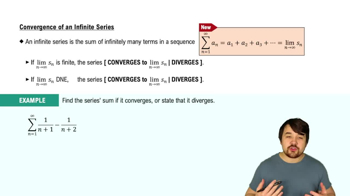
Convergence and Monotonicity of Series

A series converges if its partial sums approach a finite limit. For series with positive, decreasing terms like 1/k², partial sums are increasing and approach the limit from below, which affects whether they underestimate or overestimate the total sum.
Video consigliato:
Percorso guidato
06:52
Convergence of an Infinite Series

Comparison and Counterexamples in Series Analysis

To verify statements about series, one uses comparison tests or constructs counterexamples. For the series ∑ 1/k², known results and inequalities help confirm if partial sums underestimate the total sum or not.
Video consigliato:
Percorso guidato
06:00
Geometric Series
Pratica correlata
Domanda del libro di testo

72–75. {Use of Tech} Practical sequences

Consider the following situations that generate a sequence


d.Using a calculator or a graphing utility, estimate the limit of the sequence or state that it does not exist.


Drug elimination

Jack took a 200-mg dose of a pain killer at midnight. Every hour, 5% of the drug is washed out of his bloodstream. Let dₙ be the amount of drug in Jack’s blood n hours after the drug was taken, where d₀ = 200mg.

35
views
Domanda del libro di testo

87. Explain why or why not

Determine whether the following statements are true and give an explanation or counterexample.


e. ∑ (k = 1 to ∞) (π / e)⁻ᵏ is a convergent geometric series.

45
views
Domanda del libro di testo

41–44. {Use of Tech} Remainders and estimates Consider the following convergent series.


d. Find an interval in which the value of the series must lie if you approximate it using ten terms of the series.


41. ∑ (k = 1 to ∞) 1 / k⁶

60
views
Domanda del libro di testo

87. Explain why or why not

Determine whether the following statements are true and give an explanation or counterexample.


d. If ∑ pᵏ diverges, then ∑ (p + 0.001)ᵏ diverges, for a fixed real number p.

44
views
Domanda del libro di testo

Explain why or why not Determine whether the following statements are true and give an explanation or counterexample.


d. The Ratio Test is always inconclusive when applied to ∑ aₖ, where aₖ is a nonzero rational function of k.

48
views
Domanda del libro di testo

Explain why or why not

Determine whether the following statements are true and give an explanation or counterexample.


d.If {aₙ} = {1, ½, ⅓, ¼, ⅕, …} and

{bₙ} = {1, 0, ½, 0, ⅓, 0, ¼, 0, …},

then limₙ→∞aₙ = limₙ→∞bₙ.

43
views