
Ch. 10 - Sequences and Infinite Series
Briggs - Calculus: Early Transcendentals 3rd Edition
Briggs3rd EditionCalculus: Early TranscendentalsISBN: 9780136847243Non è quello che usi tu?Cambia libro di testo
Capitolo 10, Problema 10.3.87d

87. Explain why or why not
Determine whether the following statements are true and give an explanation or counterexample.


d. If ∑ pᵏ diverges, then ∑ (p + 0.001)ᵏ diverges, for a fixed real number p.

Guida verificata passo dopo passo
1
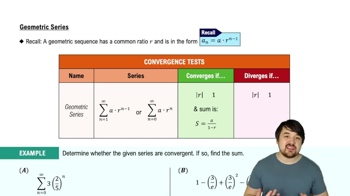
Recall the behavior of geometric series: For a fixed real number \( r \), the series \( \sum r^k \) converges if and only if \( |r| < 1 \), and diverges otherwise.
Given that \( \sum p^k \) diverges, this means that \( |p| \geq 1 \). This is the key starting point for analyzing the series \( \sum (p + 0.001)^k \).
Consider the value of \( |p + 0.001| \). Since \( p \) is fixed, adding 0.001 shifts the base slightly. We need to determine if this new base still satisfies \( |p + 0.001| \geq 1 \) or not.
If \( |p + 0.001| \geq 1 \), then \( \sum (p + 0.001)^k \) also diverges by the geometric series test. However, if \( |p + 0.001| < 1 \), then \( \sum (p + 0.001)^k \) converges, providing a counterexample to the statement.
Therefore, to conclude whether the statement is true or false, analyze specific values of \( p \) where \( |p| = 1 \) and see how the small increment affects convergence or divergence.

Risposta video verificata per un problema simile:

Questa soluzione video è stata consigliata dai nostri tutor come utile per risolvere questo problema.
Durata del video:
3m

Concetti chiave

Ecco i concetti essenziali che devi comprendere per rispondere correttamente alla domanda.

Geometric Series and Convergence Criteria

A geometric series ∑ r^k converges if and only if the absolute value of the common ratio |r| is less than 1. If |r| ≥ 1, the series diverges. This criterion is fundamental to analyzing series of the form ∑ p^k and ∑ (p + 0.001)^k.
Video consigliato:
Percorso guidato
06:00
Geometric Series

Effect of Changing the Common Ratio on Series Convergence

Altering the common ratio by a small amount (e.g., adding 0.001) can change whether the series converges or diverges. Even a slight increase can push the ratio beyond the convergence boundary, affecting the series' behavior significantly.
Video consigliato:
Percorso guidato
06:52
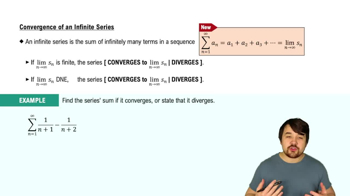
Convergence of an Infinite Series

Counterexamples in Series Convergence

To determine the truth of a statement about series convergence, constructing counterexamples is essential. For instance, if ∑ p^k diverges but ∑ (p + 0.001)^k converges, this disproves the statement. Counterexamples help clarify the limits of general claims.
Video consigliato:
Percorso guidato
06:52
Convergence of an Infinite Series
Pratica correlata
Domanda del libro di testo

41–44. {Use of Tech} Remainders and estimates Consider the following convergent series.


d. Find an interval in which the value of the series must lie if you approximate it using ten terms of the series.


43. ∑ (k = 1 to ∞) 1 / 3ᵏ

137
views
Domanda del libro di testo

72–75. {Use of Tech} Practical sequences

Consider the following situations that generate a sequence


d.Using a calculator or a graphing utility, estimate the limit of the sequence or state that it does not exist.


Drug elimination

Jack took a 200-mg dose of a pain killer at midnight. Every hour, 5% of the drug is washed out of his bloodstream. Let dₙ be the amount of drug in Jack’s blood n hours after the drug was taken, where d₀ = 200mg.

35
views
Domanda del libro di testo

41–44. {Use of Tech} Remainders and estimates Consider the following convergent series.


d. Find an interval in which the value of the series must lie if you approximate it using ten terms of the series.


41. ∑ (k = 1 to ∞) 1 / k⁶

60
views
Domanda del libro di testo

Explain why or why not Determine whether the following statements are true and give an explanation or counterexample.


d. The Ratio Test is always inconclusive when applied to ∑ aₖ, where aₖ is a nonzero rational function of k.

48
views
Domanda del libro di testo

Explain why or why not

Determine whether the following statements are true and give an explanation or counterexample.


d.If {aₙ} = {1, ½, ⅓, ¼, ⅕, …} and

{bₙ} = {1, 0, ½, 0, ⅓, 0, ¼, 0, …},

then limₙ→∞aₙ = limₙ→∞bₙ.

43
views
Domanda del libro di testo

Explain why or why not Determine whether the following statements are true and give an explanation or counterexample.


d. Every partial sum Sₙ of the series ∑ (k = 1 to ∞) 1 / k² underestimates the exact value of ∑ (k = 1 to ∞) 1 / k².

39
views