
Ch. 10 - Sequences and Infinite Series
Briggs - Calculus: Early Transcendentals 3rd Edition
Briggs3rd EditionCalculus: Early TranscendentalsISBN: 9780136847243Non è quello che usi tu?Cambia libro di testo
Capitolo 10, Problema 10.2.83d

Explain why or why not
Determine whether the following statements are true and give an explanation or counterexample.


d.If {aₙ} = {1, ½, ⅓, ¼, ⅕, …} and
{bₙ} = {1, 0, ½, 0, ⅓, 0, ¼, 0, …},
then limₙ→∞aₙ = limₙ→∞bₙ.

Guida verificata passo dopo passo
1
Step 1: Identify the sequences given. The sequence \( \{a_n\} = \left\{1, \frac{1}{2}, \frac{1}{3}, \frac{1}{4}, \frac{1}{5}, \ldots \right\} \) and the sequence \( \{b_n\} = \left\{1, 0, \frac{1}{2}, 0, \frac{1}{3}, 0, \frac{1}{4}, 0, \ldots \right\} \).
Step 2: Recall the definition of the limit of a sequence. A sequence \( \{x_n\} \) converges to a limit \( L \) if for every \( \epsilon > 0 \), there exists an \( N \) such that for all \( n > N \), \( |x_n - L| < \epsilon \).
Step 3: Analyze the limit of \( \{a_n\} \). Since \( a_n = \frac{1}{n} \), as \( n \to \infty \), \( a_n \to 0 \) because the terms get arbitrarily close to zero.
Step 4: Analyze the limit of \( \{b_n\} \). Notice that \( b_n \) alternates between terms of the form \( \frac{1}{k} \) (for odd indices) and 0 (for even indices). Consider the subsequences: \( b_{2k-1} = \frac{1}{k} \) and \( b_{2k} = 0 \). Both subsequences tend to 0 as \( k \to \infty \).
Step 5: Conclude that since both subsequences of \( \{b_n\} \) tend to 0, the entire sequence \( \{b_n\} \) converges to 0. Therefore, \( \lim_{n \to \infty} a_n = \lim_{n \to \infty} b_n = 0 \).

Risposta video verificata per un problema simile:

Questa soluzione video è stata consigliata dai nostri tutor come utile per risolvere questo problema.
Durata del video:
3m

Concetti chiave

Ecco i concetti essenziali che devi comprendere per rispondere correttamente alla domanda.

Limit of a Sequence

The limit of a sequence is the value that the terms of the sequence approach as the index n goes to infinity. If the terms get arbitrarily close to a specific number, the sequence is said to converge to that limit. Understanding this helps determine if two sequences share the same limit.
Video consigliato:
8:22
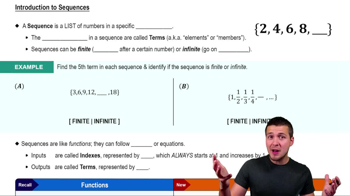
Introduction to Sequences

Behavior of Subsequences

A subsequence is a sequence derived by selecting terms from the original sequence without changing their order. The limit of a sequence must be consistent with the limits of all its subsequences. If subsequences have different limits, the original sequence does not converge.
Video consigliato:
03:07
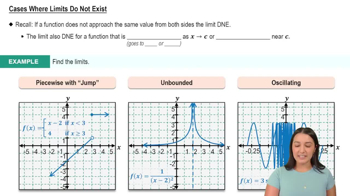
Cases Where Limits Do Not Exist

Zero Terms in a Sequence and Their Impact on Limits

Introducing zero terms intermittently in a sequence can affect its limit behavior. If zeros appear infinitely often and do not approach the original sequence's limit, the overall sequence may fail to converge or converge to a different limit. This concept is key to comparing the limits of {aₙ} and {bₙ}.
Video consigliato:
5:17
Arithmetic Sequences - General Formula
Pratica correlata
Domanda del libro di testo

41–44. {Use of Tech} Remainders and estimates Consider the following convergent series.


d. Find an interval in which the value of the series must lie if you approximate it using ten terms of the series.


43. ∑ (k = 1 to ∞) 1 / 3ᵏ

137
views
Domanda del libro di testo

72–75. {Use of Tech} Practical sequences

Consider the following situations that generate a sequence


d.Using a calculator or a graphing utility, estimate the limit of the sequence or state that it does not exist.


Drug elimination

Jack took a 200-mg dose of a pain killer at midnight. Every hour, 5% of the drug is washed out of his bloodstream. Let dₙ be the amount of drug in Jack’s blood n hours after the drug was taken, where d₀ = 200mg.

35
views
Domanda del libro di testo

72–75. {Use of Tech} Practical sequences

Consider the following situations that generate a sequence


d.Using a calculator or a graphing utility, estimate the limit of the sequence or state that it does not exist.


Radioactive decay

A material transmutes 50% of its mass to another element every 10 years due to radioactive decay. Let Mₙ be the mass of the radioactive material at the end of the nᵗʰ decade, where the initial mass of the material is M₀ = 20g.

58
views
Domanda del libro di testo

87. Explain why or why not

Determine whether the following statements are true and give an explanation or counterexample.


d. If ∑ pᵏ diverges, then ∑ (p + 0.001)ᵏ diverges, for a fixed real number p.

44
views
Domanda del libro di testo

Explain why or why not Determine whether the following statements are true and give an explanation or counterexample.

d. If ∑ aₖ diverges, then ∑ |aₖ| diverges.

40
views
Domanda del libro di testo

Explain why or why not Determine whether the following statements are true and give an explanation or counterexample.


d. Every partial sum Sₙ of the series ∑ (k = 1 to ∞) 1 / k² underestimates the exact value of ∑ (k = 1 to ∞) 1 / k².

39
views