
Ch. 11 - Power Series
Briggs - Calculus: Early Transcendentals 3rd Edition
Briggs3rd EditionCalculus: Early TranscendentalsISBN: 9780136847243Non è quello che usi tu?Cambia libro di testo
Capitolo 11, Problema 11.4.22

Limits Evaluate the following limits using Taylor series.
lim ₓ→∞ x(e¹/ˣ − 1)

Guida verificata passo dopo passo
1
Recognize that the limit involves the expression \(x \left(e^{1/x} - 1\right)\) as \(x\) approaches infinity, which suggests using the Taylor series expansion of the exponential function around 0.
Recall the Taylor series expansion for \(e^t\) around \(t=0\): \[e^t = 1 + t + \frac{t^2}{2!} + \frac{t^3}{3!} + \cdots\]
Substitute \(t = \frac{1}{x}\) into the series to get: \[e^{1/x} = 1 + \frac{1}{x} + \frac{1}{2x^2} + \frac{1}{6x^3} + \cdots\]
Rewrite the original expression using this expansion: \[x \left(e^{1/x} - 1\right) = x \left(\frac{1}{x} + \frac{1}{2x^2} + \frac{1}{6x^3} + \cdots \right)\]
Simplify the expression by multiplying \(x\) inside the parentheses and then analyze the behavior of each term as \(x \to \infty\) to determine the limit.

Risposta video verificata per un problema simile:

Questa soluzione video è stata consigliata dai nostri tutor come utile per risolvere questo problema.
Durata del video:
3m

Concetti chiave

Ecco i concetti essenziali che devi comprendere per rispondere correttamente alla domanda.

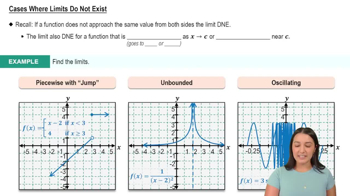
Limits at Infinity

Limits at infinity describe the behavior of a function as the input grows without bound. Understanding how functions behave as x approaches infinity helps determine if the function approaches a finite value, infinity, or does not exist.
Video consigliato:
03:07
Cases Where Limits Do Not Exist

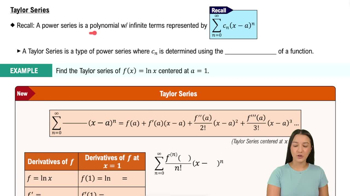
Taylor Series Expansion

A Taylor series represents a function as an infinite sum of terms calculated from its derivatives at a single point. It approximates functions near that point, allowing simplification of complex expressions, especially useful for evaluating limits.
Video consigliato:
08:42
Taylor Series

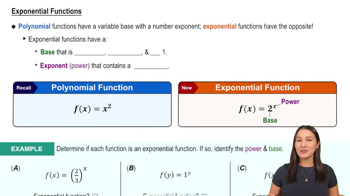
Exponential Function and Its Expansion

The exponential function e^x can be expanded as a Taylor series: e^x = 1 + x + x²/2! + ... . For small values of x, this expansion helps approximate e^(1/x) and analyze the limit by substituting the series into the expression.
Video consigliato:
6:13
Exponential Functions
Pratica correlata
Domanda del libro di testo

{Use of Tech} Newton's derivation of the sine and arcsine series Newton discovered the binomial series and then used it ingeniously to obtain many more results. Here is a case in point.

a. Referring to the figure, show that x = sin s or s = sin ⁻¹ x.

b. The area of a circular sector of radius r subtended by an angle θ is 1/2r²θ. Show that the area of the circular sector APE is s/2, which implies that

s = 2 ∫₀ˣ √(1 − t²) dt − x √(1 −x²)

c. Use the binomial series for f(x) = √(1 − x²) to obtain the first few terms of the Taylor series for s=sin ⁻¹ x.

d. Newton next inverted the series in part (c) to obtain the Taylor series for x=sin s. He did this by assuming sin s = ∑ aₖ sᵏ and solving x = sin(sin ⁻¹ x) for the coefficients aₖ. Find the first few terms of the Taylor series for sin s using this idea (a computer algebra system might be helpful as well).

124
views
Domanda del libro di testo

Manipulating Taylor series Use the Taylor series in Table 11.5 to find the first four nonzero terms of the Taylor series for the following functions centered at 0.


(1 + x⁴)⁻¹

61
views
Domanda del libro di testo

Power series for derivatives


a. Differentiate the Taylor series centered at 0 for the following functions.

b. Identify the function represented by the differentiated series.

c. Give the interval of convergence of the power series for the derivative.


f(x) = (1 − x)⁻¹

61
views
Domanda del libro di testo

Suppose f(0)=1, f'(0)=0, f''(0)=2, and f⁽³⁾(0)=6. Find the third-order Taylor polynomial for f centered at 0 and use it to approximate f(0.2).

56
views
Domanda del libro di testo

Approximating real numbers Use an appropriate Taylor series to find the first four nonzero terms of an infinite series that is equal to the following numbers.

√e

68
views
Domanda del libro di testo

Limits Evaluate the following limits using Taylor series.

lim ₓ→₄ (x² 16)/(ln (x 3)}

75
views