Ch. 11 - Power Series
Briggs - Calculus: Early Transcendentals 3rd Edition
Briggs3rd EditionCalculus: Early TranscendentalsISBN: 9780136847243Non è quello che usi tu?Cambia libro di testo
Capitolo 11, Problema 11.4.30

Power series for derivatives


a. Differentiate the Taylor series centered at 0 for the following functions.
b. Identify the function represented by the differentiated series.
c. Give the interval of convergence of the power series for the derivative.


f(x) = (1 − x)⁻¹

Guida verificata passo dopo passo
1
Start with the given function \( f(x) = (1 - x)^{-1} \). Recall that its Taylor series centered at 0 (Maclaurin series) is the geometric series \( \sum_{n=0}^{\infty} x^n \), valid for \( |x| < 1 \).
Differentiate the series term-by-term. The derivative of \( f(x) \) is \( f'(x) = \frac{d}{dx} (1 - x)^{-1} \). Using the power series, differentiate each term \( x^n \) to get \( n x^{n-1} \). So the differentiated series is \( \sum_{n=1}^{\infty} n x^{n-1} \).
Identify the function represented by the differentiated series. Differentiate \( f(x) = (1 - x)^{-1} \) directly using the chain rule: \( f'(x) = (1 - x)^{-2} \). This matches the sum of the differentiated series, confirming the function represented by the series.
Determine the interval of convergence for the differentiated series. Since the original series converges for \( |x| < 1 \), and differentiation does not change the radius of convergence, the interval remains \( (-1, 1) \).
Summarize: The differentiated power series is \( \sum_{n=1}^{\infty} n x^{n-1} \), representing the function \( (1 - x)^{-2} \), and it converges for \( |x| < 1 \).

Risposta video verificata per un problema simile:

Questa soluzione video è stata consigliata dai nostri tutor come utile per risolvere questo problema.
Durata del video:
2m

Concetti chiave

Ecco i concetti essenziali che devi comprendere per rispondere correttamente alla domanda.

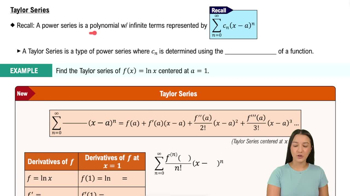
Taylor Series and Power Series

A Taylor series represents a function as an infinite sum of terms calculated from the function's derivatives at a single point, often zero (Maclaurin series). It expresses functions as power series, allowing approximation and analysis of functions using polynomials.
Video consigliato:
08:42
Taylor Series

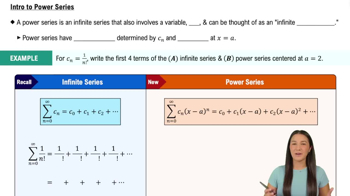
Term-by-Term Differentiation of Power Series

Power series can be differentiated term-by-term within their interval of convergence. Differentiating each term individually produces a new power series representing the derivative of the original function, preserving convergence properties inside the interval.
Video consigliato:
05:58
Intro to Power Series

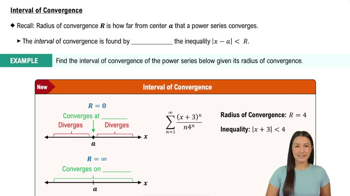
Interval of Convergence

The interval of convergence is the set of x-values for which a power series converges. Differentiating a power series does not change its radius of convergence, so the interval for the derivative series is the same or possibly smaller, requiring verification at endpoints.
Video consigliato:
08:44
Interval of Convergence