Ch. 2 - Limits
Briggs - Calculus: Early Transcendentals 3rd Edition
Briggs3rd EditionCalculus: Early TranscendentalsISBN: 9780136847243Non è quello che usi tu?Cambia libro di testo
Capitolo 2, Problema 2.32a

A rock is dropped off the edge of a cliff, and its distance s (in feet) from the top of the cliff after t seconds is s(t)=16t^2. Assume the distance from the top of the cliff to the ground is 96 ft.


a. When will the rock strike the ground? 

Guida verificata passo dopo passo
1
We need to find the time \( t \) when the rock hits the ground. This happens when the distance \( s(t) \) equals the height of the cliff, which is 96 feet.
We have the distance function \( s(t) = 16t^2 \). Set this equal to 96 to find when the rock hits the ground: \( 16t^2 = 96 \).
Divide both sides of the equation by 16 to isolate \( t^2 \): \( t^2 = \frac{96}{16} \).
Calculate \( \frac{96}{16} \) to simplify the equation to \( t^2 = 6 \).
Take the square root of both sides to find \( t \): \( t = \sqrt{6} \). Remember to consider only the positive root since time cannot be negative.>

Risposta video verificata per un problema simile:

Questa soluzione video è stata consigliata dai nostri tutor come utile per risolvere questo problema.
Durata del video:
2m

Concetti chiave

Ecco i concetti essenziali che devi comprendere per rispondere correttamente alla domanda.

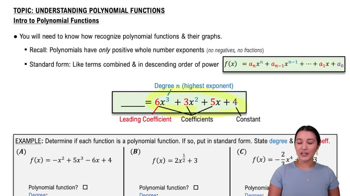
Quadratic Functions

The function s(t) = 16t^2 is a quadratic function, which represents a parabolic relationship between time t and distance s. In this context, it models the distance fallen by the rock over time due to gravity. Understanding the properties of quadratic functions, such as their vertex and roots, is essential for determining when the rock will hit the ground.
Video consigliato:
6:04
Introduction to Polynomial Functions

Roots of Equations

Finding when the rock strikes the ground involves solving for the roots of the equation s(t) = 16t^2. The roots represent the values of t when the distance s equals zero, indicating the moment the rock reaches the ground. This requires setting the equation equal to the height of the cliff (96 ft) and solving for t.
Video consigliato:
5:02
Solving Logarithmic Equations

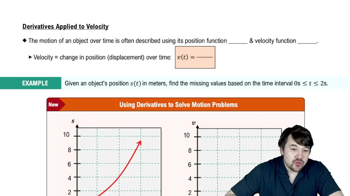
Physical Interpretation of Motion

In this scenario, the physical interpretation of motion under gravity is crucial. The equation s(t) = 16t^2 derives from the physics of free fall, where the distance fallen is proportional to the square of the time elapsed. Recognizing this relationship helps in understanding the implications of the calculated time when the rock strikes the ground.
Video consigliato:
Percorso guidato
06:29
Derivatives Applied To Velocity
Pratica correlata