Ch. 2 - Limits
Briggs - Calculus: Early Transcendentals 3rd Edition
Briggs3rd EditionCalculus: Early TranscendentalsISBN: 9780136847243Non è quello che usi tu?Cambia libro di testo
Capitolo 2, Problema 2.5.53a

Complete the following steps for the given functions. 


a. Find the slant asymptote of ff.


f(x)=x2−2x+53x−2f\(\left\)(x\(\right\))=\(\frac{x^2-2x+5}{3x-2}\)

Guida verificata passo dopo passo
1
Perform polynomial long division of the numerator \(x^2 - 2x + 5\) by the denominator \(3x - 2\).
Divide the leading term of the numerator \(x^2\) by the leading term of the denominator \(3x\) to get the first term of the quotient, \(\frac{1}{3}x\).
Multiply the entire divisor \(3x - 2\) by \(\frac{1}{3}x\) and subtract the result from the original numerator \(x^2 - 2x + 5\).
Repeat the process with the new polynomial obtained after subtraction to find the next term of the quotient.
The slant asymptote is the linear part of the quotient obtained from the division, which is \(y = \frac{1}{3}x + \text{(constant)}\).

Risposta video verificata per un problema simile:

Questa soluzione video è stata consigliata dai nostri tutor come utile per risolvere questo problema.
Durata del video:
4m

Concetti chiave

Ecco i concetti essenziali che devi comprendere per rispondere correttamente alla domanda.

Slant Asymptote

A slant (or oblique) asymptote occurs when the degree of the numerator of a rational function is exactly one higher than the degree of the denominator. To find it, you perform polynomial long division on the function. The quotient (ignoring the remainder) gives the equation of the slant asymptote, which describes the behavior of the function as x approaches infinity or negative infinity.
Video consigliato:
Percorso guidato
5:37
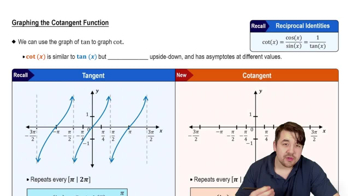
Introduction to Cotangent Graph

Polynomial Long Division

Polynomial long division is a method used to divide a polynomial by another polynomial of lower degree. It involves dividing the leading term of the numerator by the leading term of the denominator, multiplying the entire denominator by this result, and subtracting it from the numerator. This process is repeated until the degree of the remainder is less than that of the denominator, allowing us to find the slant asymptote.
Video consigliato:
6:04
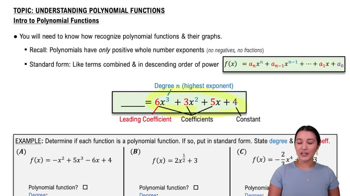
Introduction to Polynomial Functions

Rational Functions

Rational functions are expressions formed by the ratio of two polynomials. They can exhibit various behaviors, including vertical and horizontal asymptotes, depending on the degrees of the numerator and denominator. Understanding the properties of rational functions is crucial for analyzing their graphs and determining their asymptotic behavior, including the identification of slant asymptotes.
Video consigliato:
6:04
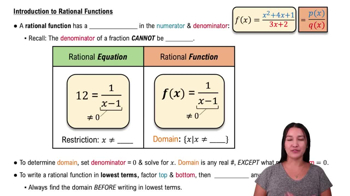
Intro to Rational Functions