Ch. 2 - Limits
Briggs - Calculus: Early Transcendentals 3rd Edition
Briggs3rd EditionCalculus: Early TranscendentalsISBN: 9780136847243Non è quello che usi tu?Cambia libro di testo
Capitolo 2, Problema 2.4.29a

Determine the following limits.


a. limx→2+1x(x−2){\(\displaystyle\)\(\lim\)_{x\(\to\)2^{+}}}\(\frac{1}{\sqrt{x\left(x-2\right)}\)}

Guida verificata passo dopo passo
1
Step 1: Identify the limit expression: \( \lim_{x \to 2^{+}} \frac{1}{\sqrt{x(x-2)}} \). This is a one-sided limit as \( x \) approaches 2 from the right.
Step 2: Analyze the behavior of the expression as \( x \to 2^{+} \). Note that \( x - 2 \) approaches 0 from the positive side, making the expression inside the square root approach 0.
Step 3: Consider the expression \( \sqrt{x(x-2)} \). As \( x \to 2^{+} \), \( x \) is slightly greater than 2, so \( x(x-2) \) is a small positive number, and \( \sqrt{x(x-2)} \) is also a small positive number.
Step 4: Evaluate the behavior of the entire fraction \( \frac{1}{\sqrt{x(x-2)}} \). As \( \sqrt{x(x-2)} \) approaches 0 from the positive side, the fraction approaches infinity.
Step 5: Conclude that the limit is \( +\infty \) as \( x \to 2^{+} \), since the denominator approaches 0 from the positive side, causing the fraction to grow without bound.

Risposta video verificata per un problema simile:

Questa soluzione video è stata consigliata dai nostri tutor come utile per risolvere questo problema.
Durata del video:
1m

Concetti chiave

Ecco i concetti essenziali che devi comprendere per rispondere correttamente alla domanda.

Limits

A limit is a fundamental concept in calculus that describes the behavior of a function as its input approaches a certain value. It helps in understanding how functions behave near points of interest, including points where they may not be defined. In this question, we are specifically looking at the limit as x approaches 2 from the right, which is denoted as x → 2⁺.
Video consigliato:
05:50
One-Sided Limits

One-Sided Limits

One-sided limits refer to the value that a function approaches as the input approaches a specific point from one side only. The limit from the right (denoted as x → c⁺) considers values greater than c, while the limit from the left (x → c⁻) considers values less than c. This distinction is crucial in this problem, as we are evaluating the limit as x approaches 2 from the right.
Video consigliato:
05:50
One-Sided Limits

Square Root Function

The square root function, denoted as √x, is defined for non-negative values of x and is important in this limit problem. The expression under the square root, x(x - 2), must be non-negative for the limit to be defined. Understanding the behavior of the square root function near critical points, such as where the argument becomes zero, is essential for evaluating the limit correctly.
Video consigliato:
Percorso guidato
7:24
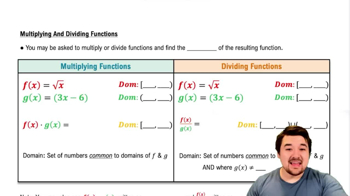
Multiplying & Dividing Functions
Pratica correlata
Domanda del libro di testo

The graph of f in the figure has vertical asymptotes at x=1 and x=2. Analyze the following limits. <IMAGE>

lim x→1^− f(x)

363
views

Domanda del libro di testo

Complete the following steps for the given functions. 


a. Find the slant asymptote of ff.


f(x)=x2−2x+53x−2f\(\left\)(x\(\right\))=\(\frac{x^2-2x+5}{3x-2}\)

462
views
Domanda del libro di testo

Complete the following steps for the given functions. 


a. Find the slant asymptote of ff.


f(x)=3x2−2x+53x+4f\(\left\)(x\(\right\))=\(\frac{3x^2-2x+5}{3x+4}\)

392
views
Domanda del libro di testo

Given the graph of f in the following figures, find the slope of the secant line that passes through (0,0) and (h,f(h))in terms of h, for h>0 and h<0.


f(x)=x1/3 <IMAGE>

362
views
Domanda del libro di testo

The hyperbolic cosine function, denoted cosh(x)\(\cosh\)\(\left\)(x\(\right\)), is used to model the shape of a hanging cable (a telephone wire, for example). It is defined as cosh(x)=ex+e−x2\(\cosh\)\(\left\)(x\(\right\))=\(\frac{e^{x}\)+e^{-x}}{2}.


a. Determine its end behavior by analyzing limx→∞cosh(x){\(\displaystyle\[\lim\)_{x\(\to\]\infty\)}{\(\cosh\)(x)}} and limx→−∞cosh(x){\(\displaystyle\)\(\lim\)_{x\(\to\)-\(\infty\)}{\(\cosh\)(x)}}.

503
views
Domanda del libro di testo

A rock is dropped off the edge of a cliff, and its distance s (in feet) from the top of the cliff after t seconds is s(t)=16t^2. Assume the distance from the top of the cliff to the ground is 96 ft.


a. When will the rock strike the ground? 

446
views