Ch. 2 - Limits
Briggs - Calculus: Early Transcendentals 3rd Edition
Briggs3rd EditionCalculus: Early TranscendentalsISBN: 9780136847243Non è quello che usi tu?Cambia libro di testo
Capitolo 2, Problema 2.4.62

Use analytical methods and/or a graphing utility to identify the vertical asymptotes (if any) of the following functions.
h(x)=e^x(x+1)^3

Guida verificata passo dopo passo
1
Step 1: Identify the form of the function h(x) = e^x (x+1)^3. Notice that it is a product of an exponential function and a polynomial.
Step 2: Recall that vertical asymptotes occur where the function is undefined or where the limit of the function approaches infinity as x approaches a certain value.
Step 3: Analyze the polynomial part (x+1)^3. Vertical asymptotes typically occur where the denominator of a rational function is zero, but since (x+1)^3 is not in the denominator, it does not contribute to vertical asymptotes.
Step 4: Consider the exponential part e^x. The exponential function e^x is defined for all real numbers and does not contribute to vertical asymptotes.
Step 5: Conclude that since neither part of the function h(x) = e^x (x+1)^3 leads to division by zero or undefined behavior, there are no vertical asymptotes for this function.

Risposta video verificata per un problema simile:

Questa soluzione video è stata consigliata dai nostri tutor come utile per risolvere questo problema.
Durata del video:
2m

Concetti chiave

Ecco i concetti essenziali che devi comprendere per rispondere correttamente alla domanda.

Vertical Asymptotes

Vertical asymptotes occur in a function when the output approaches infinity as the input approaches a certain value. This typically happens when the function is undefined at that point, often due to division by zero. Identifying vertical asymptotes involves finding values of x that make the denominator of a rational function zero, while ensuring the numerator is not also zero at those points.
Video consigliato:
Percorso guidato
3:40
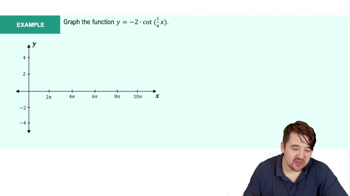
Introduction to Cotangent Graph Example 1

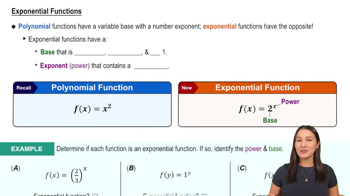
Exponential Functions

Exponential functions, such as h(x) = e^x, are characterized by a constant base raised to a variable exponent. These functions grow rapidly and are always positive, meaning they do not have vertical asymptotes. Understanding their behavior is crucial when analyzing composite functions, as they can influence the overall shape and limits of the function.
Video consigliato:
6:13
Exponential Functions

Polynomial Functions

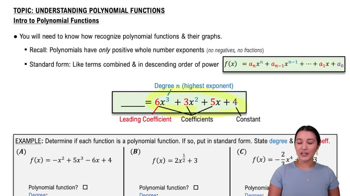
Polynomial functions, like (x+1)^3, are expressions consisting of variables raised to whole number powers. They are continuous and defined for all real numbers, meaning they do not have vertical asymptotes. Analyzing the degree and roots of polynomial functions helps in understanding their behavior, particularly in conjunction with other function types in composite expressions.
Video consigliato:
6:04
Introduction to Polynomial Functions