Ch. 2 - Limits
Briggs - Calculus: Early Transcendentals 3rd Edition
Briggs3rd EditionCalculus: Early TranscendentalsISBN: 9780136847243Non è quello che usi tu?Cambia libro di testo
Capitolo 2, Problema 2.5.57

Determine the end behavior of the following transcendental functions by analyzing appropriate limits. Then provide a simple sketch of the associated graph, showing asymptotes if they exist. 
f(x)=−3e−xf\(\left\)(x\(\right\))=-3e^{-x}

Guida verificata passo dopo passo
1
Identify the function: \( f(x) = -3e^{-x} \). This is an exponential function with a negative exponent.
Analyze the limit as \( x \to \infty \): Since \( e^{-x} \to 0 \) as \( x \to \infty \), \( f(x) = -3e^{-x} \to 0 \). Therefore, the function approaches 0 from below.
Analyze the limit as \( x \to -\infty \): As \( x \to -\infty \), \( e^{-x} \to \infty \), so \( f(x) = -3e^{-x} \to -\infty \).
Determine horizontal asymptote: From the limit as \( x \to \infty \), the horizontal asymptote is \( y = 0 \).
Sketch the graph: The graph approaches the horizontal asymptote \( y = 0 \) from below as \( x \to \infty \) and decreases without bound as \( x \to -\infty \).

Risposta video verificata per un problema simile:

Questa soluzione video è stata consigliata dai nostri tutor come utile per risolvere questo problema.
Durata del video:
4m

Concetti chiave

Ecco i concetti essenziali che devi comprendere per rispondere correttamente alla domanda.

End Behavior of Functions

End behavior refers to the behavior of a function as the input values approach positive or negative infinity. For transcendental functions like exponential functions, understanding end behavior helps predict how the function behaves far away from the origin. This is crucial for sketching graphs and identifying asymptotes.
Video consigliato:
5:46
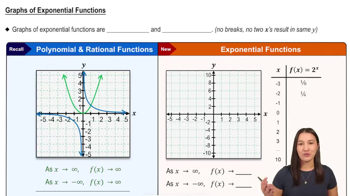
Graphs of Exponential Functions

Limits

Limits are fundamental in calculus, used to describe the value that a function approaches as the input approaches a certain point. In the context of end behavior, limits at infinity help determine the horizontal asymptotes of a function. For the function f(x) = -3e^(-x), evaluating the limit as x approaches infinity reveals its behavior.
Video consigliato:
05:50
One-Sided Limits

Asymptotes

Asymptotes are lines that a graph approaches but never touches. They can be vertical, horizontal, or oblique. For the function f(x) = -3e^(-x), identifying horizontal asymptotes involves analyzing the limits at infinity, which indicates the value the function approaches as x becomes very large.
Video consigliato:
Percorso guidato
5:37
Introduction to Cotangent Graph