Ch. 2 - Limits
Briggs - Calculus: Early Transcendentals 3rd Edition
Briggs3rd EditionCalculus: Early TranscendentalsISBN: 9780136847243Non è quello che usi tu?Cambia libro di testo
Capitolo 2, Problema 2.2.27

Use a graph of f to estimate limx→af(x){\(\displaystyle\)\(\lim\)_{x\(\to\) a}f\(\left\)(x\(\right\))} or to show that the limit does not exist. Evaluate f(x) near x=ax=a to support your conjecture.
f(x)=x−2ln∣x−2∣f\(\left\)(x\(\right\))=\(\frac{x-2}{\ln\left|x-2\right|}\); a=2a=2

Guida verificata passo dopo passo
1
Identify the function and the point of interest: We have \( f(x) = \frac{x-2}{\ln|x-2|} \) and we are interested in the limit as \( x \to 2 \).
Recognize the indeterminate form: As \( x \to 2 \), both the numerator \( x-2 \) and the denominator \( \ln|x-2| \) approach 0, indicating a \( \frac{0}{0} \) indeterminate form.
Apply L'Hôpital's Rule: Since we have a \( \frac{0}{0} \) form, we can use L'Hôpital's Rule, which involves differentiating the numerator and the denominator separately.
Differentiate the numerator and denominator: The derivative of the numerator \( x-2 \) is 1, and the derivative of the denominator \( \ln|x-2| \) is \( \frac{1}{x-2} \).
Evaluate the new limit: Substitute the derivatives back into the limit expression to get \( \lim_{x \to 2} \frac{1}{\frac{1}{x-2}} \), which simplifies to \( \lim_{x \to 2} (x-2) \). Analyze this limit to determine if it exists or not.

Risposta video verificata per un problema simile:

Questa soluzione video è stata consigliata dai nostri tutor come utile per risolvere questo problema.
Durata del video:
6m

Concetti chiave

Ecco i concetti essenziali che devi comprendere per rispondere correttamente alla domanda.

Limits

A limit describes the behavior of a function as its input approaches a certain value. It is essential for understanding continuity and the behavior of functions near points where they may not be explicitly defined. In this context, we are interested in the limit of f(x) as x approaches 2, which helps determine the function's value or behavior at that point.
Video consigliato:
05:50
One-Sided Limits

Continuity

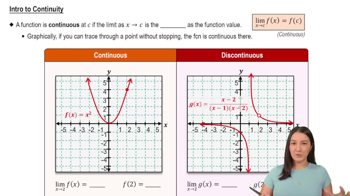
A function is continuous at a point if the limit of the function as it approaches that point equals the function's value at that point. For the function f(x) given, checking continuity at x = 2 involves evaluating the limit as x approaches 2 and comparing it to f(2). If they are not equal, the function is discontinuous at that point.
Video consigliato:
05:34
Intro to Continuity

Indeterminate Forms

Indeterminate forms occur in calculus when evaluating limits leads to expressions like 0/0 or ∞/∞, which do not provide clear information about the limit's value. In this case, as x approaches 2, both the numerator and denominator of f(x) approach 0, indicating an indeterminate form. Techniques such as L'Hôpital's Rule or algebraic manipulation may be needed to resolve these forms and find the limit.
Video consigliato:
3:56
Slope-Intercept Form