Ch. 2 - Limits
Briggs - Calculus: Early Transcendentals 3rd Edition
Briggs3rd EditionCalculus: Early TranscendentalsISBN: 9780136847243Non è quello che usi tu?Cambia libro di testo
Capitolo 2, Problema 2.45

Determine the following limits.
lim w→∞ (ln w2) / (ln w3 + 1)

Guida verificata passo dopo passo
1
Identify the limit expression: \( \lim_{w \to \infty} \frac{\ln w^2}{\ln w^3 + 1} \).
Simplify the expression: \( \ln w^2 = 2 \ln w \) and \( \ln w^3 = 3 \ln w \).
Rewrite the limit using the simplified expressions: \( \lim_{w \to \infty} \frac{2 \ln w}{3 \ln w + 1} \).
Factor out \( \ln w \) from the denominator: \( \lim_{w \to \infty} \frac{2 \ln w}{\ln w (3 + \frac{1}{\ln w})} \).
Cancel \( \ln w \) and evaluate the limit: \( \lim_{w \to \infty} \frac{2}{3 + \frac{1}{\ln w}} \).

Risposta video verificata per un problema simile:

Questa soluzione video è stata consigliata dai nostri tutor come utile per risolvere questo problema.
Durata del video:
2m

Concetti chiave

Ecco i concetti essenziali che devi comprendere per rispondere correttamente alla domanda.

Limits

Limits are fundamental concepts in calculus that describe the behavior of a function as its input approaches a certain value. In this case, we are interested in the limit of a function as w approaches infinity. Understanding limits helps in analyzing the asymptotic behavior of functions and is crucial for evaluating expressions that may not be directly computable.
Video consigliato:
05:50
One-Sided Limits

Natural Logarithm

The natural logarithm, denoted as ln, is the logarithm to the base e, where e is approximately 2.71828. It is a key function in calculus, particularly in growth and decay problems. In the given limit, the natural logarithm of w raised to a power is involved, which simplifies to a multiplication of the exponent and ln(w), illustrating the properties of logarithms.
Video consigliato:
05:18
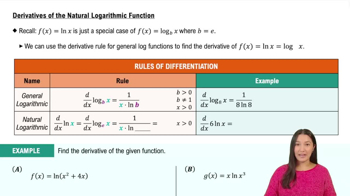
Derivative of the Natural Logarithmic Function

L'Hôpital's Rule

L'Hôpital's Rule is a method used to evaluate limits that result in indeterminate forms, such as 0/0 or ∞/∞. It states that if the limit of f(x)/g(x) leads to an indeterminate form, the limit can be found by taking the derivative of the numerator and the derivative of the denominator. This rule is particularly useful in the context of the given limit, as it can simplify the evaluation of the logarithmic expressions.
Video consigliato:
5:50
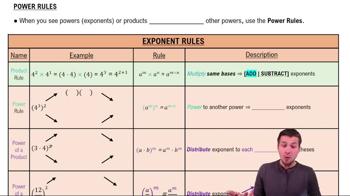
Power Rules
Pratica correlata
Domanda del libro di testo

Sketch a possible graph of a function f that satisfies all of the given conditions. Be sure to identify all vertical and horizontal asymptotes.

f(−1)=−2f\(\left\)(-1\(\right\))=-2, f(1)=2f\(\left\)(1\(\right\))=2, f(0)=0f\(\left\)(0\(\right\))=0, limx→∞f(x)=1{\(\displaystyle\[\lim\)_{x\(\to\]\infty\)}{f(x)=1}}, limx→−∞f(x)=−1{\(\displaystyle\)\(\lim\)_{x\(\to\)-\(\infty\)}{f(x)=-1}}

521
views
Domanda del libro di testo

Evaluate each limit and justify your answer. 

lim x→5 ln 6(√x^2−16−3) / 5x−25

362
views
Domanda del libro di testo

Evaluate limx→∞f(x){\(\displaystyle\[\lim\)_{x\(\to\]\infty\)}{f(x)}} andlimx→−∞f(x){\(\displaystyle\)\(\lim\)_{x\(\to\)-\(\infty\)}{f(x)}}.


f(x)=4x3+11−x3f\(\left\)(x\(\right\))=\(\frac{4x^3+1}{1-x^3}\)

315
views
Domanda del libro di testo

Describe the end behavior of g(x) = e-2x.

408
views
Domanda del libro di testo

Use a graph of f to estimate limx→af(x){\(\displaystyle\)\(\lim\)_{x\(\to\) a}f\(\left\)(x\(\right\))} or to show that the limit does not exist. Evaluate f(x) near x=ax=a to support your conjecture.

f(x)=x−2ln∣x−2∣f\(\left\)(x\(\right\))=\(\frac{x-2}{\ln\left|x-2\right|}\); a=2a=2

391
views
Domanda del libro di testo

Determine limx→∞f(x)\(\lim\)_{x\(\rightarrow\)\(\infty\)}f\(\left\)(x\(\right\)) and limx→−∞f(x)\(\lim\)_{x\(\rightarrow\)-\(\infty\)}f\(\left\)(x\(\right\)) for the following functions. Then give the horizontal asymptotes of ff (if any).


f(x)=4x3+12x3+16x6+1f\(\left\)(x\(\right\))=\(\frac{4x^3+1}{2x^3+\sqrt{16x^6+1}\)}

320
views